


























Stadiums With the Best Atmosphere in Germany
German football culture has a character of its own. The matchday ritual feels less like an event and more like a weekly gathering of the faithful, complete with colour, noise and a sense of belonging that clubs guard fiercely. Some grounds take this even further, turning ninety minutes into something closer to theatre. Here are the stadiums where the air seems to vibrate a little more than usual.
Signal Iduna Park, Borussia Dortmund
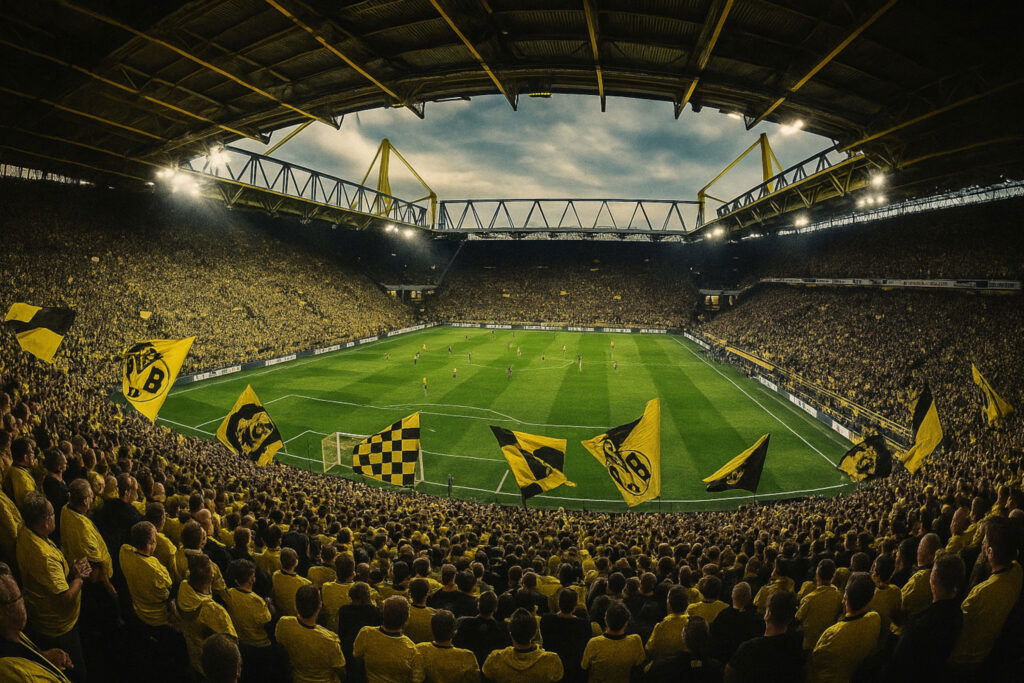
There is no escaping the pull of Dortmund’s famous Yellow Wall. It is not only the size of the stand, although that would be enough for most stadiums. It is the way supporters move in rhythm, the flags that sweep through the air and the kind of low, rolling chorus that feels almost seismic. As a historian, I sometimes imagine chroniclers of old trying to describe this racket with quills trembling in their hands.
Away fans talk about the experience with a mixture of awe and dread. Home fans treat it like a birthright. When Dortmund score, the whole stadium seems to lean forward at once.
Allianz Arena, Bayern Munich
Bayern’s home is sleek and polished but it carries a surprising edge when the occasion demands it. The exterior glows in club colours, which adds to the anticipation long before kick off. Inside, the acoustics trap noise and push it back onto the pitch.
The crowd can shift gears quickly. One moment it is a steady hum of confidence and the next it is a fierce, unified roar. The sense of entitlement that comes with decades of success gives it a particular flavour. It is less chaos and more command.
Veltins Arena, Schalke 04
Schalke supporters have never been shy about announcing their presence to the world. The Veltins Arena has a kind of raw, industrial energy that fits the region’s identity. When the roof is closed, the sound becomes something close to a physical force.
There is also a sincerity to Schalke’s matchdays. The club may suffer wild swings in form but the atmosphere stays loyal, almost defiant. You can feel the history under every chant, which adds weight to even the quieter fixtures.
Volksparkstadion, Hamburg
Hamburg’s stadium carries a nostalgic warmth that blends nicely with the club’s stubborn ambition. Even during their years outside the top flight, the supporters maintained volume levels that many Bundesliga sides could only envy.
When HSV score, the stadium bounces in that slightly uneven way that older grounds often do. It feels lived in, shaped by decades of triumph and frustration. The crowd sing with gusto because they know exactly what the badge means.
Stadion An der Alten Försterei, Union Berlin
If you ever want to see what supporter ownership looks like in sound form, this is the place. Union’s ground is old fashioned in the best way. Most fans still stand and the atmosphere feels communal, almost like a neighbourhood gathering that somehow grew into a top division force.
There is no pretence here. The noise comes from genuine commitment. Even the Christmas carol tradition carries its own charm. On matchday, everything feels close, loud and personal.
Millerntor Stadion, FC St Pauli
This is football culture with a conscience and a heavy dose of attitude. St Pauli fans create an atmosphere that sits somewhere between a political rally and a street festival. The stands sway, the banners are unapologetic and the chanting has a rhythm that suggests half the crowd could form a band if they wished.
It is not the biggest stadium but it rarely needs to be. The place is overflowing with identity and the noise matches it.
Mercedes Benz Arena, VfB Stuttgart
Stuttgart have rediscovered their spark, and the atmosphere has blossomed with the revival. The stadium has a crisp, modern layout that helps amplify the songs. Fans cling tightly to tradition, which gives the noise a steady and almost stubborn quality.
When the team play with confidence, you can feel the lift across every tier. It is a city that loves its football and shows it proudly.
RheinEnergieStadion, FC Köln
Cologne fans are some of the most passionate in the country. Their stadium turns into a wall of red and white that thrives on emotion. Even when the team struggle, the singing rarely dips below full strength.
There is a kind of carnival spirit built into the city and the stadium inherits it. It feels like the supporters arrive ready to sing even if no one else bothers showing up.
TIF Takeaway
Germany’s stadium culture thrives because supporters treat atmosphere as a shared responsibility. The noise is not just loud. It has character. Each ground has its own personality shaped by history, geography and local pride, which is why these stadiums feel so compelling.