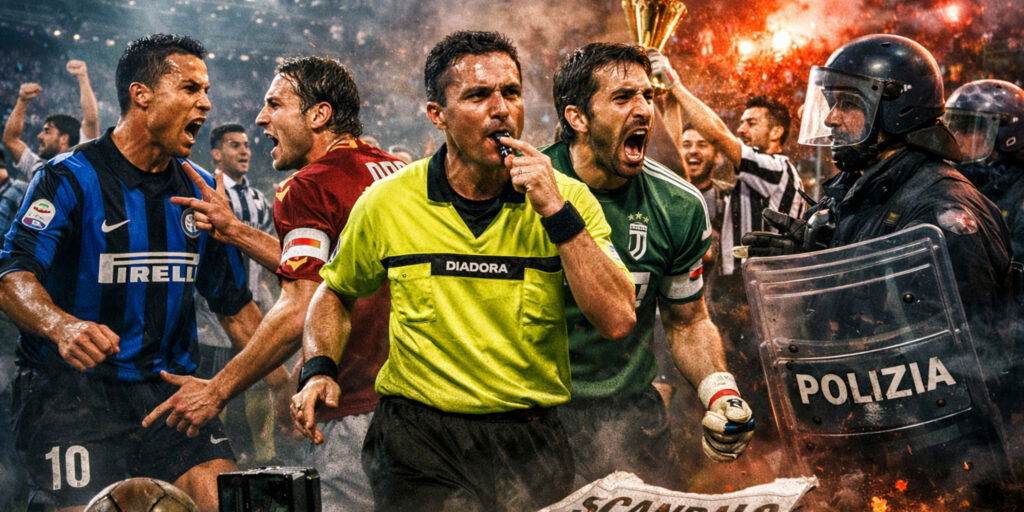
Italian football has always thrived on intensity. Tactical genius, regional pride, political undertones and fierce rivalries combine to make Serie A one of Europe’s most compelling leagues. With that passion comes friction. At times it has spilled into scandal, fury and decisions that are still debated in cafés from Turin to Palermo.
Here are the moments that still raise voices whenever they are mentioned.
Calciopoli, 2006
No controversy in Serie A history comes close to the scale of Calciopoli.
In 2006, investigations revealed a network of relationships between club executives and refereeing officials. The most prominent figure was former Juventus general manager Luciano Moggi. Phone intercepts suggested influence over referee appointments. The fallout was seismic.
Juventus were stripped of two league titles and relegated to Serie B. AC Milan, Fiorentina, Lazio and Reggina received points deductions. Italian football’s credibility suffered badly, especially coming just weeks after Italy won the World Cup.
Juventus supporters maintain the punishment was politically charged and inconsistently applied. Others argue the sanctions were necessary to restore integrity. Nearly two decades later, the debate remains raw.
The 1998 Ronaldo Penalty Incident
Inter against Juventus in April 1998 was effectively a title decider.
With Juventus leading 1 to 0, Ronaldo Nazário burst into the box and collided with defender Mark Iuliano. Inter expected a penalty. Referee Piero Ceccarini waved play on. Moments later, Juventus were awarded a penalty at the other end.
The decision fuelled claims of bias and conspiracy, particularly given Juventus’ dominance in the era. Inter manager Gigi Simoni was later dismissed, though officially for unrelated reasons.
For many Inter fans, that moment encapsulates decades of frustration. It is still replayed in highlight reels whenever rivalry week comes around.
The 2002 Final Day Collapse
On 5 May 2002, Inter travelled to Lazio knowing victory would secure the title. What followed was chaos.
Inter lost 4 to 2. At the same time, Juventus beat Udinese to claim the Scudetto. The image of Ronaldo on the bench, in tears, became one of Serie A’s most enduring photographs.
There was no single scandalous refereeing call here. Instead, suspicion lingered around competitive integrity, given Lazio’s complicated relationship with Inter and the broader politics of Italian football.
Sometimes controversy is less about proof and more about perception. That day, perception ran wild.
The 2012 Muntari Goal That Wasn’t
AC Milan against Juventus in February 2012 produced a moment that accelerated calls for goal line technology.
Sulley Muntari’s header clearly crossed the line before being clawed out by Gianluigi Buffon. The referee and assistants missed it. The match ended 1 to 1.
Juventus went on to win the title that season, finishing four points ahead of Milan. The unawarded goal could have changed everything.
The incident remains a textbook example used in arguments for technological assistance. In this case, reform followed outrage. Serie A eventually adopted goal line technology, but that did little to console Milan supporters.
Roma vs Juventus, 2014 and the “Double Standards” Debate
A dramatic 3 to 2 Juventus victory over Roma in October 2014 featured three penalties and a red card.
Roma captain Francesco Totti famously claimed there were double standards in Italian football. His words resonated with many who felt Juventus benefited from favourable decisions during their dominant run under Antonio Conte.
While refereeing reviews supported some calls, the optics were damaging. The match intensified scrutiny of officials and added fuel to an already combustible rivalry.
Italian football does not need much encouragement to question authority. That night gave critics plenty to work with.
Fan Unrest and the 2007 Catania Tragedy
Not all controversy centres on referees or boardrooms.
In February 2007, violent clashes between Catania and Palermo supporters led to the death of police officer Filippo Raciti. The tragedy forced the suspension of league matches and prompted sweeping security reforms.
Italian stadium culture was placed under a harsh spotlight. Measures included stricter ticketing rules, improved surveillance and temporary stadium closures.
It was a sobering moment that reminded everyone that football’s intensity carries responsibility. The game paused to reflect, and rightly so.
VAR and the Modern Era
Video Assistant Referee technology arrived in Serie A in 2017 with the promise of clarity. Instead, it introduced a new layer of argument.
Supporters debate handball interpretations, offside margins and the consistency of reviews. Managers gesture at pitch side monitors as if they are confronting fate itself.
VAR has reduced certain types of error. It has not reduced controversy. If anything, it has made disputes more forensic. Slow motion can clarify, but it can also amplify doubt.
Italian football remains what it has always been, fiercely proud and deeply argumentative.
TiF Takeaway
Serie A’s history is intertwined with politics, regional identity and powerful institutions. Decisions are rarely viewed in isolation. They are interpreted through decades of rivalry and suspicion.
That tension is part of the league’s identity. It fuels debate shows, late night radio and family arguments over Sunday lunch. It also ensures that every contentious call feels larger than life.
For better or worse, controversy has shaped Serie A as much as tactics or trophies. And if history is any guide, the next flashpoint is never far away.