


























Europe’s New Rule for Electric Cars: 70% Made Here or No Subsidy
The European Commission is moving toward local content requirements that would reshape the continent’s EV market — and shut out Chinese manufacturers from billions in state support.
The European Union is drawing a line around its electric vehicle market. Under proposals now working their way through Brussels, electric cars would need to be at least 70 per cent made in Europe to qualify for state subsidies — a threshold that would effectively lock Chinese manufacturers out of billions of euros in public support while reshaping supply chains across the continent.
The move is part of a broader industrial strategy that has accelerated sharply since the Commission presented its Automotive Package in December 2025. That package, combined with the Net Zero Industry Act’s resilience criteria that took effect on 1 January 2026, signals a fundamental shift in how Europe intends to support the transition to electric vehicles: not just by subsidising demand, but by ensuring that the economic benefits of that demand stay within EU borders.
The 70 Per Cent Threshold
The 70 per cent figure has emerged as the benchmark from CLEPA, the European association of automotive suppliers, which has proposed setting the EU value threshold for “Made in Europe” status at 70 to 75 per cent of a vehicle’s total component value. The proposal deliberately mirrors the United States-Mexico-Canada Agreement, which applies similar regional value content rules for passenger cars and sets specific sub-thresholds for critical components including engines, transmissions, and batteries.
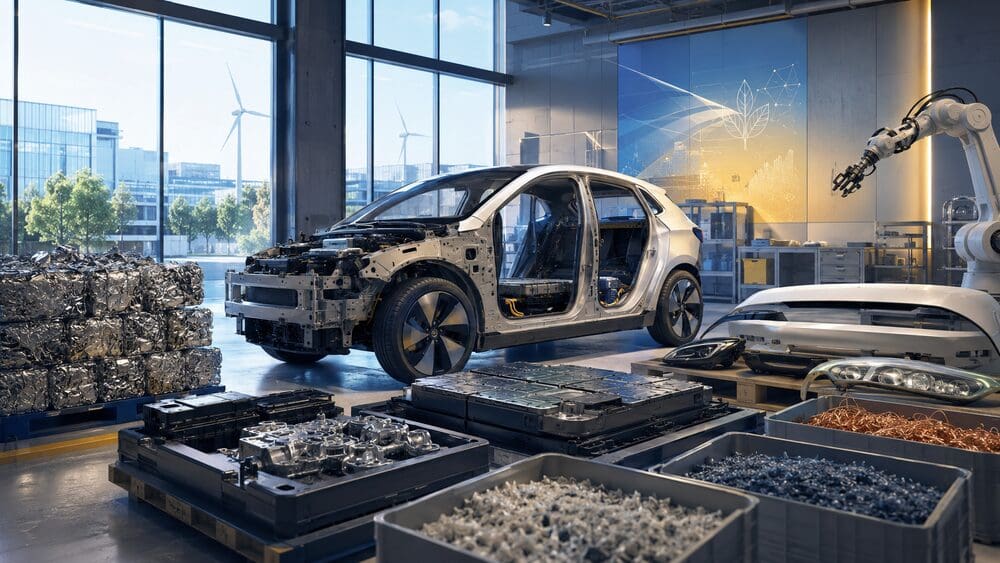
The logic is straightforward. For traditional combustion engine vehicles, Europe retains 85 to 90 per cent of the value of each car produced and sold in the EU. For battery electric vehicles, that figure drops to between 70 and 75 per cent. The reason is batteries, which account for roughly 30 per cent of an EV’s total value and are overwhelmingly sourced from Chinese supply chains. Without intervention, Europe risks subsidising its own deindustrialisation — paying taxpayer money to accelerate adoption of vehicles whose economic value accrues largely outside the bloc.
The Policy Architecture Taking Shape
The Commission has not yet formally legislated the 70 per cent threshold, but the policy architecture to support it is being assembled from multiple directions simultaneously.
Since January 2026, all EU member states are required under Article 28 of the Net Zero Industry Act to include resilience criteria in any new or updated electric vehicle subsidy scheme. The Commission’s forthcoming Industrial Accelerator Act is expected to go further, proposing explicit EU content requirements for batteries and their components wherever public support is provided. The December 2025 Automotive Package introduced “super credits” within the EU’s CO2 standards framework that reward manufacturers for producing small, affordable EVs within the EU — a mechanism designed to incentivise European production without directly banning foreign alternatives.
France has already demonstrated what this looks like in practice. Its ecological bonus system uses a carbon-based scoring methodology that evaluates the environmental footprint of both vehicle and battery production. The criteria effectively disqualify most Chinese-manufactured EVs from French subsidies, not by name but by process. The Jacques Delors Centre has argued that this French model is the most practical template for a coordinated EU-wide approach — it is effective, WTO-compliant, and ready to deploy.
Germany’s re-entry into the subsidy market reinforces the urgency. Berlin has committed approximately €3 billion to a new EV incentive programme running from 2026 to 2029, targeting low and middle-income households. Germany, France, Spain, and Italy together account for around 70 per cent of all new passenger car registrations in the EU. If those four countries coordinate their subsidy conditions — as Brussels is encouraging — the effect would cover the vast majority of the European car market.
Why This Matters Beyond Europe
The implications extend well beyond the trade tensions already roiling transatlantic commerce. China’s global car exports have surged, and Chinese manufacturers now account for approximately a quarter of EV sales in the EU. Countervailing duties imposed by the Commission on Chinese-made EVs have done little to stem the tide — Chinese firms have found exports more attractive than investing in high-cost European production, and some are pivoting to neighbouring countries like Turkey and Morocco as alternative manufacturing bases.
The local content rules are designed to change that calculus. If Chinese manufacturers want access to subsidised European demand, they will need to build genuine manufacturing capacity within the EU — not assembly operations that import subsidised components, but integrated supply chains that meet the 70 per cent threshold. BYD, CATL, and others with planned or existing European facilities would need to significantly deepen their local sourcing. Those that choose not to would forfeit access to what remains one of the world’s most lucrative EV markets.
For European manufacturers, the rules offer both protection and pressure. The struggling automotive sector — exemplified by Volkswagen’s restructuring, Stellantis’s plant closures, and the broader crisis in German manufacturing — would gain a degree of insulation from Chinese price competition. But the protection is conditional: European carmakers must still produce EVs that consumers want to buy at prices they can afford. Subsidies tied to local content do not solve the underlying competitiveness gap — they buy time to close it.
The Commission has not yet defined the precise methodology for determining when a vehicle qualifies as “made in the EU,” leaving that critical question to future delegated acts. But the direction of travel is unmistakable. Europe is building a wall around its EV market — not with tariffs alone, but with a web of subsidy conditions, content requirements, and procurement rules that together amount to the most significant shift in European industrial policy since the single market itself.
The 70 per cent threshold is where the drawbridge falls.
The post Europe’s New Rule for Electric Cars: 70% Made Here or No Subsidy appeared first on European Business & Finance Magazine.