






















Siljanovska-Davkova: It is strange to invoke the Copenhagen criteria in the enlargement process while insisting on Balkan demands
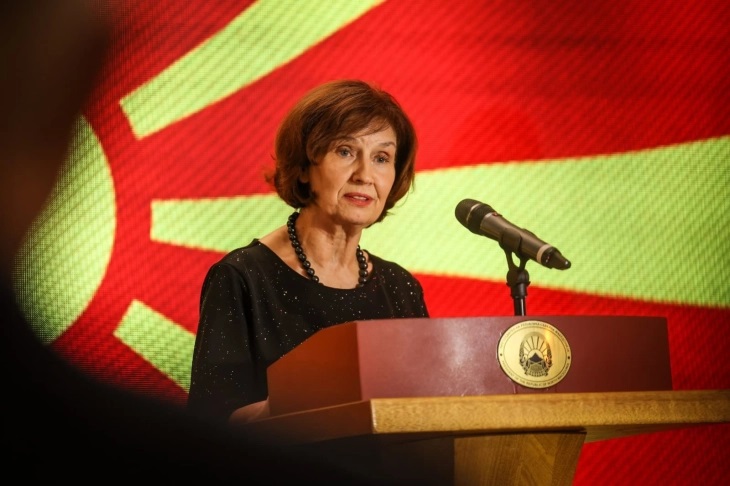
Ohrid – The international order is no longer based on international law, and even less on justice, ethics and morality, but openly invokes power, weapons are not silent but activated, the debate on harmony with nature is fading, Euro-Atlanticism is not a synonym for a coordinated and solidary alliance, President Gordana Siljanovska-Davkova emphasized in her address at the traditional annual reception for representatives of the diplomatic corps in Ohrid.
– In the anarchic international system, in the absence of checks and balances, unlimited and unsanctioned power tends to grow, so even the relatively strong becomes weak in relation to the super-strong. That is precisely why small states together with medium-sized ones must be the loudest supporters of multilateralism in an era of rampant multipolarism, old-new Goliaths, and also neo-unilateralist geopolitical, economic and energy domination, said Siljanovska-Davkova.
For the year that is ending she pointed out that Macedonia has been a credible EU partner, a responsible, active and credible NATO member, a proven factor of stability in the region.
– We cannot be Penelope who, while waiting for Odysseus, keeps changing the constitution non-stop, at the request of someone from outside, forgetting that it is the law above the laws, that is, lex superior, which should be changed rarely and with a trembling hand… How is it possible, or is it not hypocrisy and cynicism to invoke national constitutional patriotism and consensus as a barrier to changing the constitutive acts of the EU, while asking a state to meet “just one more condition”, to make “just one more concession and constitutional change”, because that is what the neighbor wants, that is what the rapporteur or the European Council recommends, she said, emphasizing the burden of living in permanent uncertainty.
It is strange, noted Siljanovska-Davkova, “to invoke the Copenhagen criteria, and to insist on Balkan demands, to expect reforms and the rule of law, while tolerating bilateralization, vetoization and double standards. Democracy is learned from democrats and with democrats. Trust is built through understanding and helping, not through conditioning and blackmail.”
In conditions of real military risks, but also with climate, energy and economic shocks, security, as she said, is not only a matter of geography and territory – but also of the resilience of institutions, the stability of society and the trust of citizens.
– We are a small state, but a culturally and spiritually competitive actor. For us, as for all of you, identity is not an argument against the EU, but an argument for the EU, because Europe is rich precisely because of its diversity… How many times have we proven that we can be a partner that personifies values, not problems, even though we are constantly treated as problematic – said Siljanovska-Davkova.
Regarding EU enlargement, she said that it is not a test only for the candidates, but also for Europe’s democratic capacity and credibility, noting that if the rules apply differently, then they are an instrument of political arbitrariness.
– Finally, the Western Balkans is not a problem of the Union’s absorption capacity. On the contrary, the integration of the region is a matter of security, stability and geopolitical rationality in a time of growing geopolitical rivalry, said the president, emphasizing that good neighborliness must not be an alibi for blockade, dialogue must not turn into an instrument of conditioning, the European process must not turn into an arena in which the bilateral will dictate the European, said the president.
She further emphasized that if enlargement becomes a mechanism in which every new member gains the right to “redefine” the path of the next one, then the Union will lose what makes it a Union: the principle of legal predictability and equality.
– The question arises: is European integration a process that Europeanizes the candidates, or a process that risks Balkanizing the European enlargement policy? We are not asking for special treatment. We are not asking for a privilege. We are asking for enlargement to be returned to where it belongs: within the framework of the Copenhagen criteria, within the framework of meritocracy, within the framework of reforms and the rule of law. Only in this way will the European perspective remain credible. Only in this way will hope remain rational, and not sentimental. And only in this way will the EU win the battle to be an inspiring, respected international actor, emphasized Siljanovska-Davkova.
(21 January 2026)