




















Historic Stadiums of Italian Football
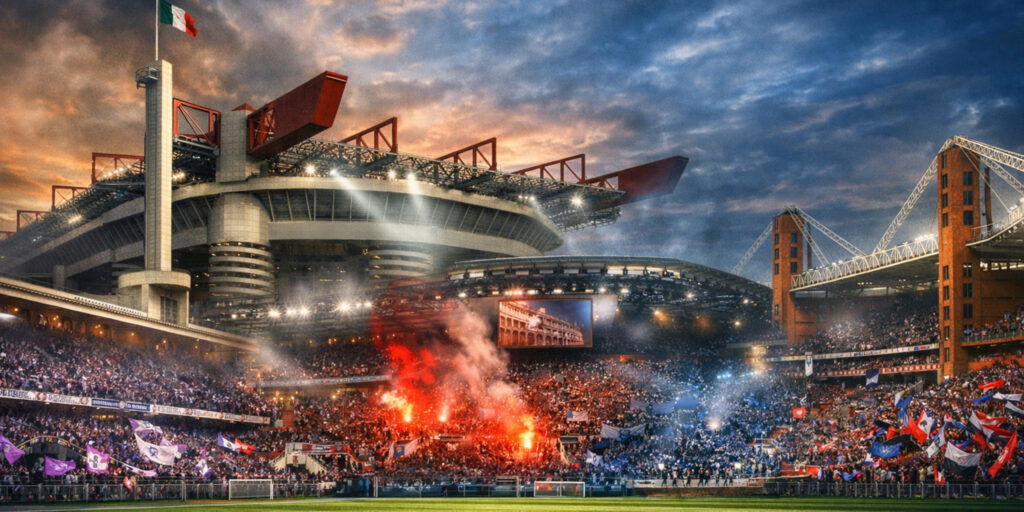
Italian football stadiums feel lived in. Many were shaped long before modern commercial pressures took over, and you can sense it in the tight stands, the acoustics, and the way the city seems to lean into the ground on matchday. This is a tour of the venues that still define the sport in Italy, not because they are perfect, but because they carry history comfortably.
San Siro (Stadio Giuseppe Meazza)
San Siro is impossible to separate from Milan itself. Opened in 1926 and later expanded into its current concrete cathedral, it has hosted World Cups, European finals, and decades of shared tenancy between rivals who rarely agree on anything else.
The spiralling towers and sheer verticality make it feel intimidating even when empty. When full, the sound rolls around the bowl in waves, especially from the Curva Sud and Curva Nord.
| Detail | Information |
|---|---|
| City | Milan |
| Opened | 1926 |
| Capacity | Approx. 75,800 |
| Home clubs | AC Milan, Inter |
| Major finals | European Cup, Champions League |
Stadio Olimpico
Built as part of Rome’s post-war redevelopment, the Olimpico sits within the Foro Italico complex and carries a slightly ceremonial feel. It has hosted Olympic ceremonies, World Cup finals, and some of the most emotionally charged derbies in Europe.
Its scale is vast rather than intimate, but when Roma or Lazio are in full voice, particularly behind the goals, it feels anything but cold.
| Detail | Information |
|---|---|
| City | Rome |
| Opened | 1953 |
| Capacity | Approx. 70,600 |
| Home clubs | Roma, Lazio |
| Other uses | Athletics, concerts |
Stadio Diego Armando Maradona
Few stadiums are as emotionally tied to a single figure. Renamed in honour of Diego Maradona, this ground in Fuorigrotta remains a place of pilgrimage for Napoli supporters.
It is not glamorous and never pretends to be. The steep stands trap noise, and the atmosphere often feels personal, even confrontational. On big European nights, it can overwhelm visiting sides long before kick-off.
| Detail | Information |
|---|---|
| City | Naples |
| Opened | 1959 |
| Capacity | Approx. 54,700 |
| Home club | Napoli |
| Renamed | 2020 |
Stadio Artemio Franchi
Designed by Pier Luigi Nervi, the Artemio Franchi is as much an architectural statement as a football ground. Its sweeping curves and famous spiral tower mark it out from almost anything else in Italian football.
Time has not been kind to its facilities, but the structure itself remains admired. There is an ongoing tension between preservation and modernisation, and for many supporters, that struggle is part of its identity.
| Detail | Information |
|---|---|
| City | Florence |
| Opened | 1931 |
| Capacity | Approx. 43,300 |
| Home club | Fiorentina |
| Design note | Italian rationalism |
Stadio Luigi Ferraris
Often overlooked internationally, the Luigi Ferraris is one of the oldest major football grounds still in use. Tucked into a residential area, it feels woven into the city rather than imposed on it.
The stands are steep, close to the pitch, and the Derby della Lanterna turns it into one of Italy’s loudest venues. There is very little space to hide here, on or off the pitch.
| Detail | Information |
|---|---|
| City | Genoa |
| Opened | 1911 |
| Capacity | Approx. 36,600 |
| Home clubs | Genoa, Sampdoria |
| Notable feature | Urban location |
Where to Buy Tickets for Italian Football Matches
Buying tickets in Italy is usually straightforward, but it rewards a bit of planning. Most clubs sell directly through their official websites, often requiring a simple registration. For high-profile matches, particularly derbies or European fixtures, demand can be intense.
Authorised resale platforms such as Vivaticket and TicketOne are widely used and reliable. Stadium ticket offices still exist at many grounds, though availability on matchday is less predictable than it once was.
For visitors, club memberships are rarely required for league matches, but identification is sometimes requested at the gate, so bring photo ID.