



















Why European Defence Budgets Should Focus on Today’s Needs
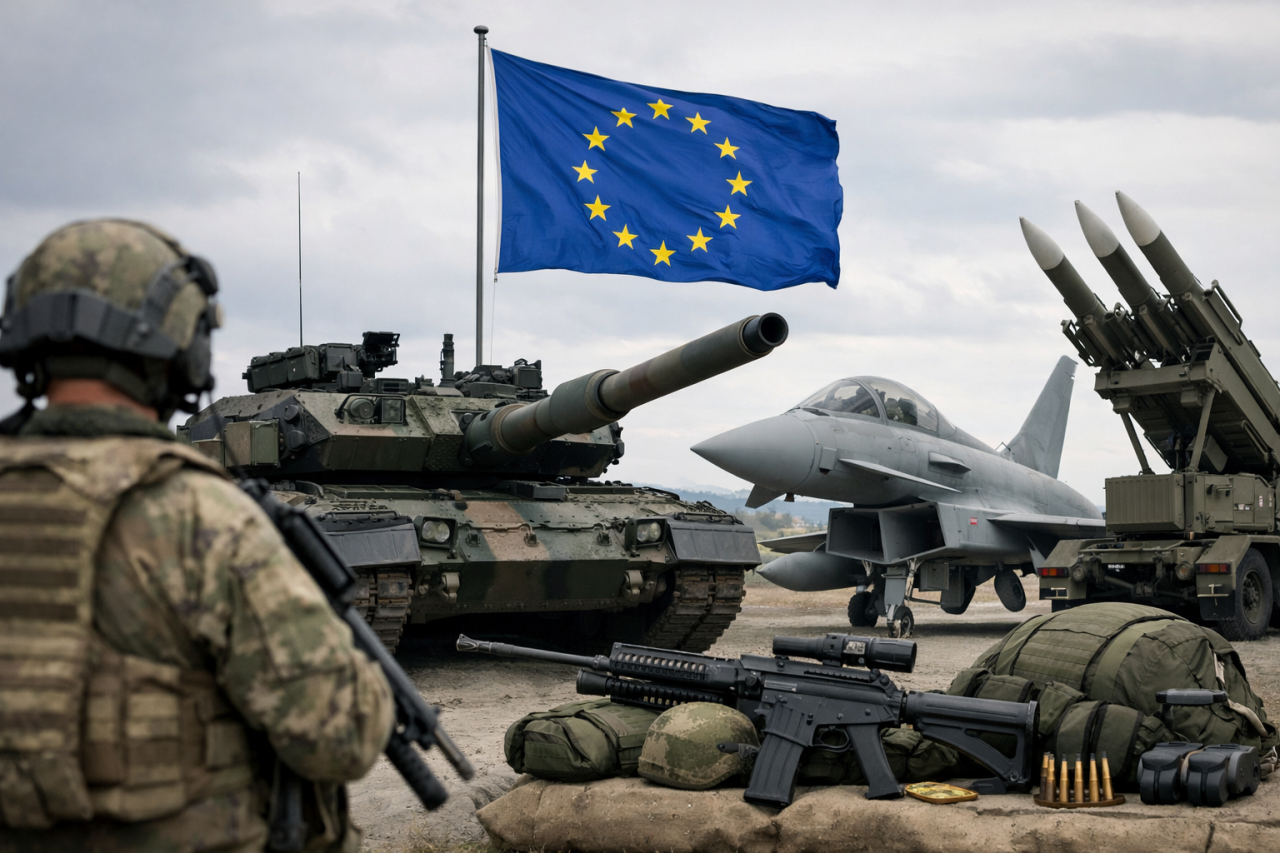
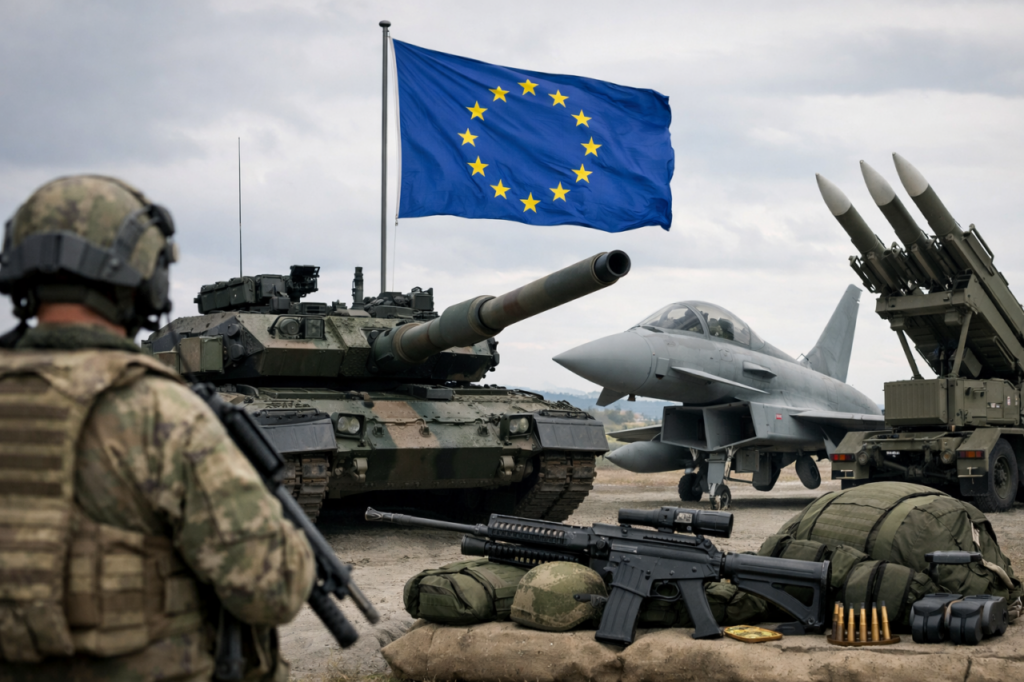
Quick Answer-Europe spent $563 billion on defence in 2025 — but Germany’s own military chief warns Russia could attack by 2029 and says Europe must be ready to fight tonight. The problem isn’t the budget. It’s that the money is going to programmes that won’t be ready until after 2030.
The Strategic Case-At the 2026 Munich Security Conference, Ursula von der Leyen told attendees that Europe is on track to surpass US defence equipment spending by 2028. With this “European awakening”, she argued, “We must grow a European backbone of strategic enablers: in space, intelligence, and deep strike capabilities… We need to get the money out the door and turn this into real defence capabilities.” Indeed, money must be spent wisely, prioritising what militaries need now to be prepared for Russian aggression.
European defence spending is up, with pledges for more, but is still not enough to immediately fill all of Europe’s defence capability gaps. This is especially true because large portions of budgets are allocated to massive programmes that won’t be ready until after 2030 instead of focusing on equipment and stockpiles needed now. This could be problematic because intelligence says Putin is preparing an attack on European soil within the next five years. Germany’s Chief of Defence, General Carsten Breuer, told BBC “This is what the analysts are assessing – in 2029. So we have to be ready by 2029… If you ask me now, is this a guarantee that’s not earlier than 2029? I would say no, it’s not. So we must be able to fight tonight.”
But are Europe’s militaries ready to face Russia? EU Defence Chief Andrius Kubilius recently observed, “… quantity alone does not bring quality. The famous British economist and historian Adam Tooze recently pointed out: In the last ten years, Europeans spent 3.1 trillion on defence. But even so – we still are not ready, to fight as Europeans,” and argues Europe must “Make sure we not only spend more, but also better and European.”
Budgets and Programmes on the Rise
The International Institute for Strategic Studies’ 2026 edition of The Military Balance highlights record-level defence spending in Europe now accounting for 22% of global defence spending (17% in 2022) with Europe allocating USD563 billion in 2025 to defence. Spending was led by Germany’s USD107.3 billion, placing it fourth worldwide behind the U.S. (921), China (531.4) and Russia (523.6). Poland is leading NATO spending percentage-wise with 4.48% of GDP allocated to defence last year.
France is lagging behind with 2.05% of its GDP, but intends to catch up quickly. Catherine Vautrin, France’s Minister of the Armed Forces, has been promoting plans to increase France’s defence spending to 2.2% of GDP for 2026, recently explaining in a speech, “this budget is a necessity, it is in no way a luxury. This is what will allow us to be ready for deterrence, munitions, stocks, mass capabilities, orders, and maintaining the operational readiness of our army model.” She goes onto argue, “And we must stand on our own two feet, combining long-term imperatives with short-term necessities.”
It is this balance of long-term versus short-term needs that begs scrutiny if Europe as a whole will be ready by 2029. EU members have multiple massive, long-term projects in the works. For example, countries are investing heavily in future space projects with €5.4 billion recently pledged by Germany for the next three years of ESA programmes. France pledged €3.6 billion, Spain pledged €1.85 billion and Italy €3.46 billion. Those are very large sums and whilst needed to end Europe’s reliance on American satellites, will take years to materialise.
Regarding military equipment, Vautrin referenced the PANG project (Porte-Avions Nouvelle Generation): France’s multi-billion Euro effort to develop one of the world’s most advanced aircraft carriers by the end of the 2030s. The carrier is designed to house the Future Combat Air System (FCAS) sixth-generation fighters.
FCAS is Europe’s most expensive weapons project at over 100 billion euros with France, Germany and Spain developing “from 2040 a new European fighter jet” to replace America’s F-35. But security expert Christian Mölling says Germany has a “…very short-term armaments agenda, which means we are buying more of what we already have and that works. And then there are future projects like the FCAS, which are not so important right now.”
Today’s Priority Is to Be Ready For Tomorrow’s Battle
This “short-term armaments agenda” is crucial if countries hope to prepare for imminent conflict including protecting from attacks, responding to them, and even deterring them. Efforts to build defensive capabilities are well underway on organised projects with big price tags. These include building a “drone wall” for countries bordering Russia (estimated one billion Euros), Poland’s East Shield programme (USD2.5 billion allocated for the next four years), integrated air defence systems through projects including the European Sky Shield Initiative (ESSI) and an “eastern flank surveillance system”.
Such capabilities are important, but will never be able to fully defend the continent. That is why building offensive capabilities that can strike within enemy territory is equally, if not more, important. Missile expert Fabian Hoffmann explains, “While missile defense can provide effective localized protection for high-value targets, it cannot protect the entirety of Europe’s territory, especially over prolonged periods. If European governments believe they could be involved in a prolonged war of attrition against Russia in the coming years, preparing for such a scenario, including by acquiring the deep-strike capabilities needed to target enemy production, is anything but optional.”
Russia crippled Ukraine’s energy infrastructure this winter with large numbers of DPS missiles. On February 20th, Ukraine hit a Russian missile factory using its domestically-produced Flamingo missile and has relied on Storm Shadow/SCALP missiles from Britain/France to hit strategic targets in Russia. Ukraine needs more DPS missiles for Russia to negotiate seriously, with Zelensky repeatedly requesting American Tomahawks and German Taurus missiles.
Europe should be providing Ukraine with such capabilities, but first and foremost, they need to be building their own stockpiles. Luckily, they have options, but they are scattered and at varying levels of maturity.
Last July, France and the UK ordered more combat-proven Storm Shadow/SCALP missiles. Germany currently has Taurus missiles and ordered 600 upcoming Taurus Neo missiles, although production dates are unknown. Berlin wants Tomahawks for the interim, but America’s latest attack on Iran using Tomahawks and HIMARS means its defence industry’s upcoming production will be directed to fill American stockpiles. France will soon test the LCM, a ‘European Tomahawk’ based on MBDA’s battle-proven MdCN, which could provide Europe with ground-launched DPS capabilities needed in Ukraine, but orders have not been announced.
France earmarked a billion euros to develop a ground-launched ballistic missile from ArianeGroup, which also interests Berlin, although is “years away”. Germany and the UK announced plans for a 2,000km DPS system, but that won’t be available until the 2030s at best. The Netherlands recently challenged domestic manufacturers to propose a national long-range missile similar to the Tomahawk, but none of these projects will be ready in time to deter Russian hostilities.
Kubilius recently addressed issues hindering missile production after speaking with European missile producers. He said, “They are not worried about profits. Volume goes up. Unit prices go down. It’s simple economics. But they are worried about risk. To produce in volume, industry first needs big orders, long term orders from Member States.”
While they claim that the Russian threat is imminent, EU leaders should prioritise urgent needs and sign orders to increase production of missiles available in time to deter Moscow – or enable nations to respond effectively if push comes to shove.
The post Why European Defence Budgets Should Focus on Today’s Needs appeared first on European Business & Finance Magazine.