





























Why Djokovic Earns More Than Nadal and Federer Combined: The $370M Business Empire Explained
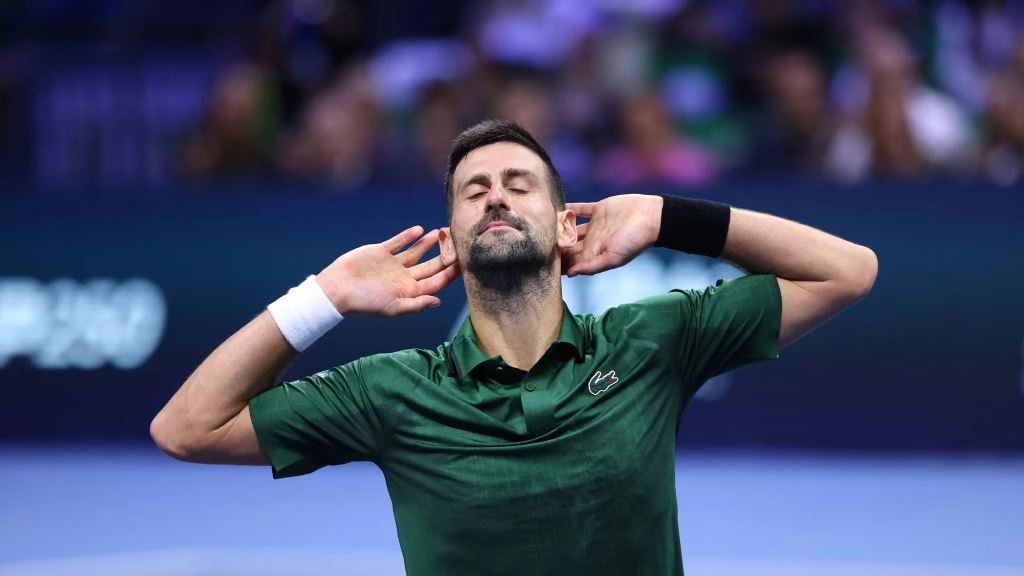
Quick Answer: Novak Djokovic’s $370 million net worth now rivals the combined recent annual earnings of Roger Federer and Rafael Nadal due to unprecedented career longevity at #1, strategic tax residency in zero-income-tax Monaco, lucrative endorsement portfolio worth $30+ million yearly, and diversified business investments spanning restaurants, real estate, and wellness brands. While Federer’s lifetime earnings ($550M) remain higher, Djokovic’s current earning power and wealth accumulation rate exceed both retired rivals combined.
How Did Djokovic Build $370 Million?
Novak Djokovic’s financial empire rests on three pillars that together generate wealth surpassing what tennis legends Roger Federer and Rafael Nadal earn in their current semi-retired or fully retired states. The Serbian’s systematic approach to wealth building—combining on-court excellence with off-court business acumen and tax optimization—creates compounding advantages that most athletes never achieve.
Career prize money of approximately $185 million makes Djokovic the highest-earning tennis player in history from tournament winnings alone, surpassing Federer’s $131 million and Nadal’s $135 million according to ATP records. This $50+ million advantage stems from Djokovic’s extraordinary longevity at peak performance levels, winning Grand Slams and Masters titles well into his mid-30s when most players decline. His 24 Grand Slam titles—more than any male player—delivered prize money that compounds exponentially given that winners earn multiples of what losing finalists or semi-finalists receive.
The prize money calculation understates Djokovic’s advantage because inflation and purse increases mean recent Grand Slam victories paid substantially more than tournaments won a decade earlier. Australian Open 2024 winners received AUD $3.15 million compared to AUD $2.5 million in 2015—Djokovic’s continued winning during high-purse years maximized earnings beyond what career title counts alone suggest.
Endorsement income generates approximately $30-35 million annually through partnerships with Lacoste (apparel), Asics (footwear), Head (racquets), Hublot (watches), and Peugeot (automobiles) among others. While this trails Federer’s endorsement peak of $90+ million yearly before retirement, it substantially exceeds Nadal’s current $23 million as the Spaniard’s injury-plagued recent years reduced marketability and playing schedule limited visibility.
Djokovic’s endorsement resilience despite controversy—including vaccine refusal that cost him Australian Open 2022 participation and potential sponsor relationships—demonstrates brand strength built over decades. Major sponsors including Lacoste stuck with him through controversy, calculating that his on-court dominance and passionate fanbase outweighed negative publicity from segments of audience opposed to his vaccination stance.
Business investments spanning restaurants, real estate, wellness brands, and sports technology create income streams independent of tennis performance. His restaurant chain in Serbia, real estate holdings in Belgrade and Monaco, supplement company Djokolife, and various technology startup investments generate returns that compound wealth beyond what endorsement and prize money alone could achieve.
Why Does Monaco Matter More Than You Think?
Djokovic’s Monaco residency since 2012 represents perhaps his single most consequential financial decision, generating tax savings that dwarf most players’ career earnings. Monaco’s zero-percent income tax means Djokovic keeps 100% of prize money and endorsement income, while comparable players residing in high-tax jurisdictions surrender 40-50% to government coffers.
Tax comparison mathematics illustrate staggering impact: if Djokovic earned $50 million annually and lived in his native Serbia (15% tax rate), he’d pay $7.5 million yearly in taxes. Residing in Spain like Nadal (47% top rate) would cost $23.5 million annually. Over a 15-year career at peak earnings, Monaco residency saves $100+ million compared to Spain or $350+ million compared to highest-tax jurisdictions like UK or California.
The savings compound because money retained can be invested, generating returns that would otherwise flow to tax authorities. Djokovic’s ability to invest his full prize money and endorsement income creates wealth accumulation impossible for players losing half their earnings to taxes before investment becomes possible.
Critics characterize Monaco residency as tax avoidance, though athletes counter that they compete globally and owe no special obligation to any single country’s tax system. The practice remains legal and widespread—approximately 70% of top-100 ATP players claim residency in low-tax jurisdictions including Monaco, Switzerland, UAE, and Bahamas according to ATP records. Formula 1 champion Lewis Hamilton, numerous footballers, and countless business executives employ identical strategies.
Lifestyle benefits beyond taxes include privacy, security, and proximity to training facilities that southern France provides. Monaco’s geographic centrality enables easy travel to European tournaments that dominate tennis calendars, reducing logistical burden compared to residing in Serbia or other less-connected locations.
How Did He Overtake Federer and Nadal?
Djokovic’s financial ascendancy over tennis’s other two legends stems from strategic advantages and timing factors that compounded over his career’s unique trajectory.
Longevity at peak performance represents Djokovic’s decisive edge. While Federer retired in 2022 at 41 and Nadal’s injuries forced semi-retirement by 35, Djokovic at 37 continues winning Grand Slams and maintaining #1 ranking periods. Each additional year at elite level generates $15-20 million in prize money and endorsements that Federer and Nadal no longer earn, creating widening gap despite Federer’s massive career earnings advantage.
The mathematics prove stark: Federer earned essentially zero prize money in 2023-2024 as retired player, while Nadal’s injury-limited schedule generated perhaps $3-5 million. Djokovic’s $15+ million in prize money plus $30+ million endorsements during those years created $40+ million advantage over the duo combined—gap that widens annually as his rivals remain retired or semi-retired while he competes.
Post-retirement endorsement decline affects Federer and Nadal’s earning power despite iconic status. Federer maintains substantial endorsement portfolio through Uniqlo, Rolex, and other lifetime partners, earning estimated $20-30 million post-retirement. However, this pales beside his playing-career peak of $90+ million yearly. Nadal’s injury-plagued final years and limited schedule reduced his endorsement value even before formal retirement. Combined, their current endorsement income might reach $50 million—which Djokovic approaches alone.
Business diversification timing favored Djokovic, who built business interests during prime earning years rather than attempting wealth conversion post-retirement. His restaurant investments and real estate acquisitions during peak earnings enabled leverage of maximum capital when opportunities arose, while many athletes only pursue serious business ventures after retirement when investment capital and market influence have diminished.
What’s the Controversy Cost?
Djokovic’s refusal to receive COVID-19 vaccination created financial consequences that most analyses estimate cost him $10-20 million through missed tournament opportunities, potential sponsor hesitation, and reputational damage in certain markets. However, his financial resilience despite controversy reveals how elite athlete brands can withstand significant negative publicity when on-court performance remains dominant.
Australian Open 2022 deportation cost approximately $2 million in prize money (he would likely have won) plus exhibition appearance fees and sponsor bonuses tied to Grand Slam victories. Subsequent tournament restrictions in countries requiring vaccination added millions more in foregone prize money and appearance fees throughout 2022.
Sponsor relationship strain manifested in various ways: some negotiations for new partnerships likely stalled or collapsed due to controversy, renewal terms may have been less favorable than pre-controversy baselines, and certain markets (particularly North America where vaccination debates proved most polarizing) potentially reduced his endorsement value. However, major sponsors including Lacoste publicly supported him, calculating that his core fanbase’s loyalty outweighed opposition from segments uncomfortable with his stance.
The controversy’s long-term financial impact appears modest—Djokovic’s 2023-2024 earnings recovered fully as tournament restrictions lifted and his continued Grand Slam dominance reminded sponsors and fans why he commands premium endorsement rates. This resilience illustrates how elite athletic performance can insulate against reputational damage that would prove catastrophic for athletes whose primary value proposition centers on image rather than achievement.
What This Reveals About Sports Wealth
Djokovic’s financial trajectory compared to Federer and Nadal illuminates broader lessons about athletic wealth accumulation that extend beyond tennis to professional sports generally.
Peak performance longevity matters more than total career length for wealth building. An athlete performing at elite level for 15 years earns multiples of comparable player performing adequately for 20 years, because prize money, endorsements, and business opportunities concentrate disproportionately at the top. Djokovic’s ability to maintain #1-level performance into late 30s creates compounding advantages that earlier retirement foreclosed for rivals despite their legendary careers.
Tax jurisdiction strategy represents wealth-building decision whose importance rivals career choices about training, coaching, and competition schedule. Athletes who thoughtfully optimize tax residency can retain 30-50% more lifetime earnings than comparable performers who remain in high-tax jurisdictions, creating wealth gaps potentially larger than on-court performance differences generate.
Timing retirement for financial optimization creates tension between health, competitive satisfaction, and wealth maximization. Federer’s 2022 retirement at 41 after injury-plagued final years probably maximized his long-term wellbeing, but cost tens of millions in foregone earnings had he competed another year or two. Djokovic’s willingness to continue competing despite achieving every possible accomplishment reflects both competitive drive and financial reality that each additional elite-level year generates wealth impossible to replicate post-retirement.
Key Takeaways
✓ Djokovic’s $370M net worth now rivals Federer and Nadal’s combined recent annual earnings due to continued competition while rivals retired, generating $40+ million yearly advantage through prize money and endorsements they no longer earn ✓ Monaco zero-percent income tax residency saved Djokovic an estimated $100-350 million over his career compared to high-tax jurisdictions, enabling wealth accumulation impossible for players surrendering half their earnings to taxes ✓ Career prize money of $185 million exceeds both Federer ($131M) and Nadal ($135M) due to unprecedented longevity winning Grand Slams into late 30s when most players decline and prize purses reached historic highs ✓ Vaccine controversy cost estimated $10-20 million through missed tournaments and potential sponsor hesitation, but brand resilience demonstrates how elite athletic performance insulates against reputational damage that would devastate image-dependent athletes ✓ Business diversification including restaurants, real estate, and wellness brands creates income streams independent of tennis performance, with investments made during peak earning years generating compounding returns unavailable to athletes who pursue business ventures only post-retirement
Related EBM Coverage:
- Athlete Wealth Building: Tax Strategies and Business Diversification
- Sports Endorsement Economics: How Performance Affects Brand Value
- Tax Optimization for High Earners: Monaco and Low-Tax Jurisdictions
- Athlete Business Investments: Building Wealth Beyond Playing Career
The post Why Djokovic Earns More Than Nadal and Federer Combined: The $370M Business Empire Explained appeared first on European Business & Finance Magazine.