
























WEEKEND READ: The Worst Possible Moment: How Trump’s Tariff Wall Is Hitting LVMH, Kering and Richemont Where It Hurts Most
Quick Answer
As of 10 April 2026, LVMH, Kering and Richemont are facing a compounding crisis: Trump’s transatlantic tariffs are threatening the US market precisely as it became European luxury’s primary growth engine, with Chinese demand still well below its 2021 peak and European consumer confidence undermined by record energy costs. One detail not in the headline — LVMH alone generates an estimated €17 billion annually from North American revenues, making the US not just its largest single market but its most irreplaceable one. Experts say the tariffs solve Washington’s trade deficit optics but create a structural pricing dilemma for luxury groups that cannot absorb costs without risking the one thing their entire model depends on — the perception of aspirational value that no discount can survive. Whether the groups raise prices, absorb margin hits or accelerate US manufacturing investment will determine the sector’s next three years — and the answer is not yet clear.
EBM Exclusive Take
The timing of Trump’s tariff escalation could hardly be more damaging for European luxury. The sector spent 2023 and 2024 managing a painful Chinese demand correction — the post-lockdown spending surge that was supposed to sustain growth evaporated faster than anyone projected, leaving LVMH, Kering and Richemont scrambling to rebalance their geographic exposure. The answer, in each case, was America. US consumers — resilient, aspirational and largely insulated from the macro pressures battering European and Asian households — became the growth engine the sector needed. Now that engine has a tariff wall in front of it, and the strategic options available to European luxury groups are considerably less attractive than their brand prestige might suggest.
The Numbers Behind the Exposure
LVMH reported North American revenues of approximately €17 billion in its most recent full year, representing roughly 25% of total group sales. For its Fashion and Leather Goods division — the highest-margin segment and the home of Louis Vuitton and Christian Dior — US exposure is even more pronounced. Kering, whose flagship Gucci brand has been navigating its own creative and commercial reset, derives a significant share of revenues from American consumers at the precise moment it can least afford additional headwinds. Richemont, whose Cartier and Van Cleef & Arpels jewellery houses have seen sustained US demand, faces tariff exposure across a product category — hard luxury — where American consumers have demonstrated exceptional willingness to spend even in uncertain environments.
The tariff structure, as currently applied, creates a direct cost pressure on European-manufactured goods entering the US market. Unlike the automotive sector, where some manufacturers have US production capacity to partially offset tariff exposure, luxury goods manufacturing is almost entirely concentrated in Europe by design. The provenance — made in France, made in Italy — is not incidental to the product. It is the product. Relocating production to the United States would solve the tariff problem and destroy the brand proposition simultaneously.
The China Problem Has Not Gone Away
What makes the US tariff threat acutely dangerous is the context in which it arrives. European luxury groups entered 2026 still waiting for a Chinese demand recovery that has consistently disappointed. The Chinese consumer — whose post-pandemic spending surge powered sector revenues through 2021 and into 2022 — has not returned at the scale or pace that analyst consensus predicted. Domestic Chinese luxury consumption has been constrained by a property market correction that has compressed household wealth, a consumer confidence deficit that has proved sticky, and a broader shift in aspirational spending patterns among younger Chinese consumers toward domestic brands and experiential rather than goods-based luxury.
LVMH’s Asia revenues, which once represented the sector’s most exciting growth story, have been in structural recalibration. Richemont’s watch division has navigated the same correction, with Swiss watch exports to China falling sharply from their peak. Kering has been particularly exposed, with Gucci’s heavy reliance on Chinese consumers leaving it vulnerable to the correction in ways that more geographically diversified brands have partially avoided.
The strategic logic of doubling down on America was sound. It was the right call given the available alternatives. Which is precisely why a tariff wall landing now is so damaging — it targets the pivot, not the retreat.
The Pricing Dilemma
 European luxury groups face a choice that has no good answer. They can absorb the tariff cost — compressing margins in their highest-revenue market at a moment when the sector is already managing cost pressures across supply chains and retail infrastructure. They can pass the cost to consumers through price increases — risking demand destruction in a market where luxury spending, while resilient, is not infinitely price-inelastic. Or they can attempt to accelerate US manufacturing investment — a process that takes years, requires significant capital, and fundamentally compromises the European provenance that justifies the price points in the first place.
According to Bloomberg, several major luxury groups have already begun internal assessments of US manufacturing feasibility — an indication of how seriously the tariff threat is being taken at board level. The consensus view among sector analysts is that meaningful US production is a medium-term option at best, and that the short-term impact of tariffs will be absorbed through a combination of price increases and margin compression whose precise ratio will vary by brand and by product category.
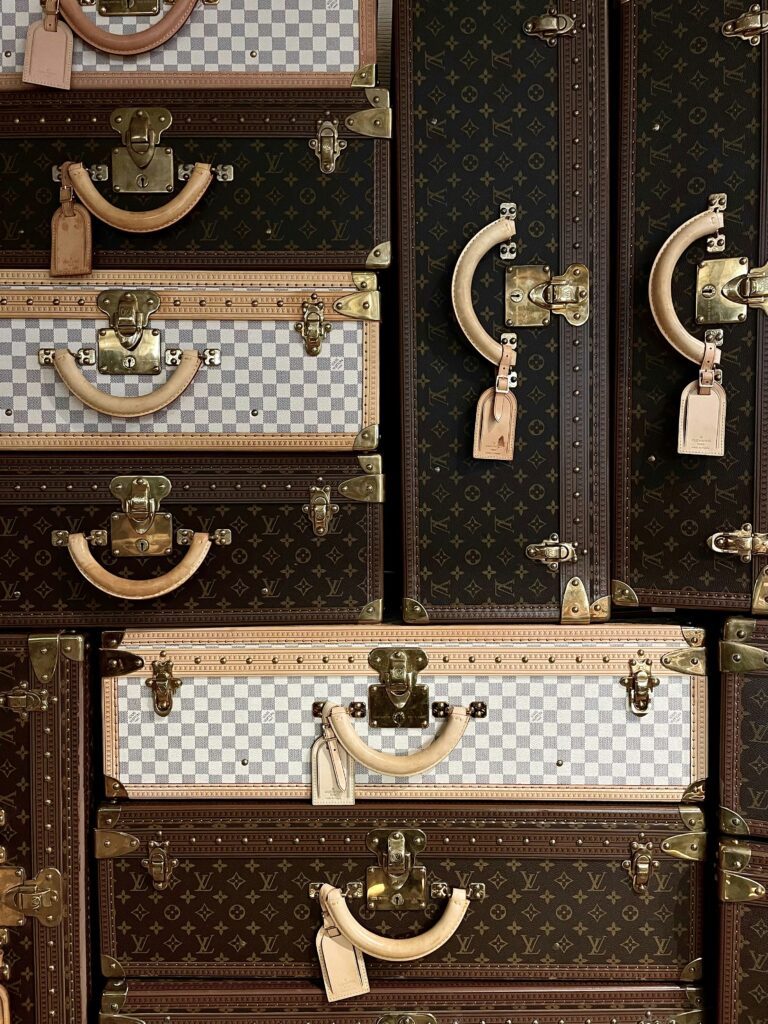
Louis Vuitton has some latitude — its pricing power is among the strongest in global luxury and its clientele skews toward the ultra-high-net-worth segment least sensitive to incremental price increases. Gucci, in the middle of a brand reset and with a more aspirational price positioning, has considerably less room to manoeuvre. The tariff wall does not hit European luxury uniformly — it hits the most exposed brands at their most vulnerable moments with the most force.
The Broader Strategic Shift
What the tariff episode has accelerated, more than any single quarter of revenue impact, is a fundamental strategic conversation about geographic dependency that European luxury groups had been deferring. A sector that was over-reliant on China discovered that dependency painfully in 2023. The corrective pivot to America has now revealed a second dependency — and the lesson is not lost on boardrooms in Paris and Geneva.
The medium-term strategic response will likely involve a more aggressive push into under-penetrated markets — the Gulf, India, Southeast Asia, Japan — and a renewed focus on European domestic luxury consumption, which has been systematically undervalued as groups chased higher-growth international markets. None of those alternatives replace the scale of the US market in the near term. But the tariff wall has made diversification an urgent priority rather than a long-term aspiration.
For now, LVMH, Kering and Richemont are navigating a storm that combines softening Chinese demand, rising US tariff costs, elevated European energy prices feeding through to input cost pressure, and a consumer confidence environment across their home markets that offers little compensatory support. The brands are strong. The balance sheets are solid. But the margin of error has narrowed considerably — and the tariff wall is not moving.
Related Analysis
- Ferrari’s Untouchable Business Model: What European Luxury Can Learn From Maranello
- Richemont and the Watch Market Correction: Two Strategies, One Crisis
- European Automakers and the EV Reckoning: Who Survives the Transition
The post WEEKEND READ: The Worst Possible Moment: How Trump’s Tariff Wall Is Hitting LVMH, Kering and Richemont Where It Hurts Most appeared first on European Business & Finance Magazine.