




















The NEOM Collapse: How Saudi Arabia Spent $50 Billion Building Almost Nothing

Quick Answer: NEOM was announced in 2017 as a $500 billion futuristic megacity in northwestern Saudi Arabia, owned and funded by the Saudi Public Investment Fund under the direct authority of Crown Prince Mohammed bin Salman. By September 2025, construction on its centrepiece — The Line, a 170-kilometre linear city designed to house 9 million people — was formally suspended after $50 billion had been spent and almost nothing built. An internal audit put the true cost of completion at $8.8 trillion, with a finish date of 2080. The project has since pivoted toward AI data centres. The biggest losers are the Saudi state, the contractors who never got paid, the consultants who enabled the fantasy, and the Howeitat tribe forcibly displaced from their land for a city that will never be built.
In October 2017, a 32-year-old Saudi Crown Prince stood before a global audience in Riyadh and announced what he called the most ambitious development project in human history. NEOM — the name combining the Greek word for “new” with the Arabic word for “future” — would be a $500 billion city built from scratch in the desert of northwestern Saudi Arabia. It would run entirely on renewable energy. It would have no roads, no cars, flying taxis and robot servants. At its heart would be The Line — a 170-kilometre linear city, 200 metres wide, 500 metres tall, stretching across desert and mountains to the Red Sea, housing 9 million people with a 20-minute commute guaranteed for every resident.
Mohammed bin Salman was not short of ambition. What he proved to be short of was everything else.
The Vision: Who Owned It and Why
NEOM was never a private project or an independent development. It was wholly owned by Saudi Arabia’s Public Investment Fund — the sovereign wealth fund that MBS chairs and effectively controls, managing assets of close to $1 trillion. The project was the centrepiece of Vision 2030, the Crown Prince’s programme to diversify the Saudi economy away from oil dependence before the world’s energy transition made that dependence terminal.
The logic was clear enough. Saudi Arabia knew its oil revenues would eventually decline. The question was what to replace them with. NEOM was the answer MBS chose: a technology hub, a tourist destination, a global innovation centre that would attract the kind of human capital and foreign direct investment that could sustain the kingdom for generations. The ambition was not merely to build a city. It was to build a new economic identity for a nation.
To execute it, Saudi Arabia hired everyone. McKinsey & Company became the dominant consulting partner — and one of the few entities that appears to have done well financially from the entire enterprise. The internal audit that eventually exposed the scale of the dysfunction found that executives, aided by McKinsey, had relied on unrealistically optimistic assumptions to justify cost overruns. Global architecture firms, engineering consultancies, and construction companies signed contracts totalling billions. By 2023 alone, 23 contracts worth approximately $16.2 billion had been awarded. Senior Western executives arrived in Saudi Arabia on extraordinary salaries. Dissenters were removed. Sceptics were dismissed.
How It Went Wrong — and the Numbers That Tell the Story
The problems were structural from the beginning, but they were hidden behind an avalanche of ambition and money. The original $500 billion estimate was already extraordinary — it exceeded the GDP of most nations. The true figure, revealed in an internal audit presented to NEOM’s board in 2024 and reported by the Wall Street Journal, was $8.8 trillion. That number is almost incomprehensible. It is more than 25 times Saudi Arabia’s entire annual government budget. It is more than four times the kingdom’s GDP. It would cost more than building 16 Interstate Highway Systems across the United States. The projected completion date in that audit: 2080.
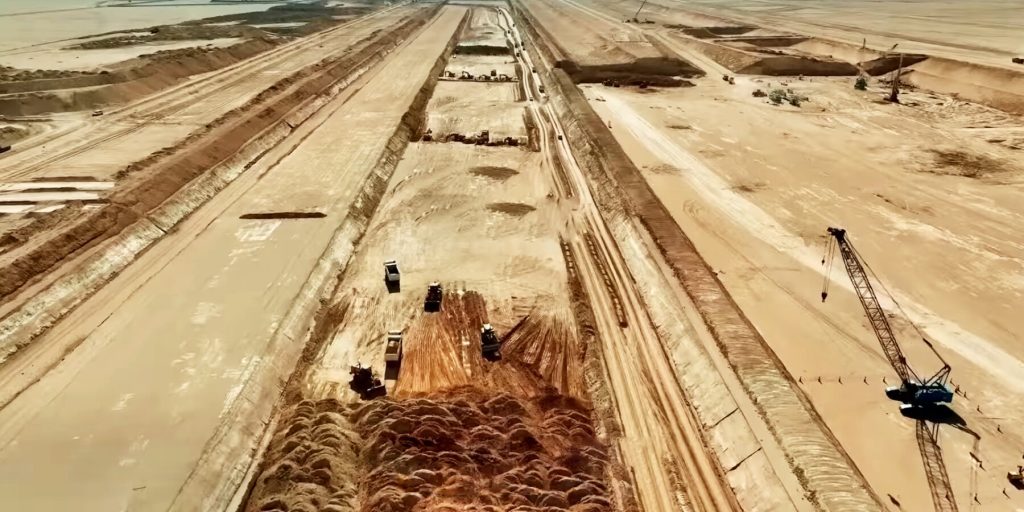
The physical reality on the ground was equally sobering. Producing the concrete required for the first operational segment of The Line would have needed quantities exceeding France’s entire annual cement output. Each 800-metre unit required 3.5 million tonnes of steel, 5.5 million cubic metres of concrete, and 3.5 million tonnes of rebar. Sixty machines worked round the clock on foundations, driving six thousand piles over two kilometres of desert at extraordinary cost — for a project that nobody with full information believed would be built. In April 2024, Bloomberg reported that the planned length of The Line had been quietly reduced from 170 kilometres to 2.4 kilometres. By September 2025, the PIF formally suspended all construction pending a strategic review.
The global energy crisis that erupted with the Iran war compounded what was already a structural funding problem. Oil prices had been hovering around $71 per barrel through mid-2025 — well below the $90-plus level that Saudi Arabia’s budget requires for fiscal balance. Aramco cut its dividend payments by approximately $40 billion for 2025, directly reducing the PIF’s cash flow. The PIF’s giga-project portfolio suffered an $8 billion write-down at the end of 2024. The Iran war then accelerated the pivot away from construction toward defence and food security spending. The money that was supposed to build the future was needed for the present.
Who Lost — and How Much
The question of who lost most from NEOM’s collapse depends on how you define loss. The Saudi state has spent at least $50 billion — the confirmed figure — and has almost nothing to show for it beyond concrete foundations in a desert, a luxury island that remains closed to the public, and a ski resort with cancelled hosting duties after Kazakhstan replaced NEOM as the 2029 Asian Winter Games venue.
The private contractors and international construction firms who signed multi-billion-dollar contracts face an uncertain path to full payment. Several large contracts for tunnelling work and the Trojena ski resort were cancelled in March 2026. The foreign investors that Saudi Arabia hoped to attract never arrived in meaningful numbers — some wealthy Saudi families put modest sums in, but the large-scale international capital Riyadh needed never materialised.
The human cost is harder to quantify but more damning. Members of the Howeitat tribe were forcibly relocated from land their families had occupied for generations to make way for The Line. Abdul Rahim al-Huwaiti — a tribe member who publicly refused to leave and filmed himself resisting eviction — was killed by Saudi security forces. Approximately 20,000 people are expected to be displaced in total. They were removed for a city that will never be built at anything approaching its promised scale.
Who Is to Blame
MBS owns this failure in the most direct sense — he conceived it, funded it, chaired it, and suppressed internal dissent when executives raised concerns. Former managers and executives have said the projections were completely unrealistic and that some refused to sign off on plans. Those who raised doubts were removed from the project. The architecture of sycophancy that surrounds absolute power produced exactly the outcome that architecture always produces: nobody told the man in charge the truth until it was too late to avoid the consequences.
McKinsey’s role deserves separate scrutiny. The firm earned hundreds of millions from NEOM consulting work. The internal audit found that it had helped construct the optimistic assumptions that justified continued spending. McKinsey is not an aberration here — it is a symptom of a broader consulting industry problem in which the incentive is to tell clients what they want to hear rather than what they need to know. The same dynamic that drove NEOM’s collapse drives the private credit industry’s opacity and the kind of hidden billionaire power that operates without accountability.
Where It Stands Now
NEOM has not been abandoned entirely — it has been pivoted. In February 2026, NEOM announced a $5 billion partnership with DataVolt to build an AI data centre campus in the Oxagon district, cooled by Red Sea seawater, operational by 2028. Saudi Arabia has committed $40 billion to AI investment through Humain, a new state AI company. The desert that was supposed to house a linear city of 9 million will instead house GPU clusters serving the global AI boom.
It is, in its way, a sensible pivot. Artificial intelligence is reshaping global infrastructure investment faster than any other force in the current economy, and the Gulf’s combination of land, energy and capital makes it genuinely well-suited to data centre development. But it is a pivot from fantasy to function, from a transformative vision to a utilitarian one — and the gap between those two things represents $50 billion spent, a tribe displaced, a man killed, and a Crown Prince’s most audacious dream quietly folded away.
The most expensive construction project in human history built almost nothing. The payments infrastructure that will define the next era of global commerce is being built by accountants and engineers in Brussels and Frankfurt. The AI infrastructure that will define the next era of intelligence is being built in data centres across the Gulf. And in the desert of northwestern Saudi Arabia, sixty metres of foundations and a handful of concrete structures stand as a monument to what happens when ambition is untethered from physics, finance, and accountability.
Related Analysis
- The Hidden Billionaires: Europe’s 10 Most Powerful Private Companies in 2026
- BlackRock Just Told Investors They Can’t Have Their Money Back
- How Artificial Intelligence Is Reshaping the Global Economy
The post The NEOM Collapse: How Saudi Arabia Spent $50 Billion Building Almost Nothing appeared first on European Business & Finance Magazine.