




























Spain Makes Its Move for the ECB Presidency — The Race Is Now On
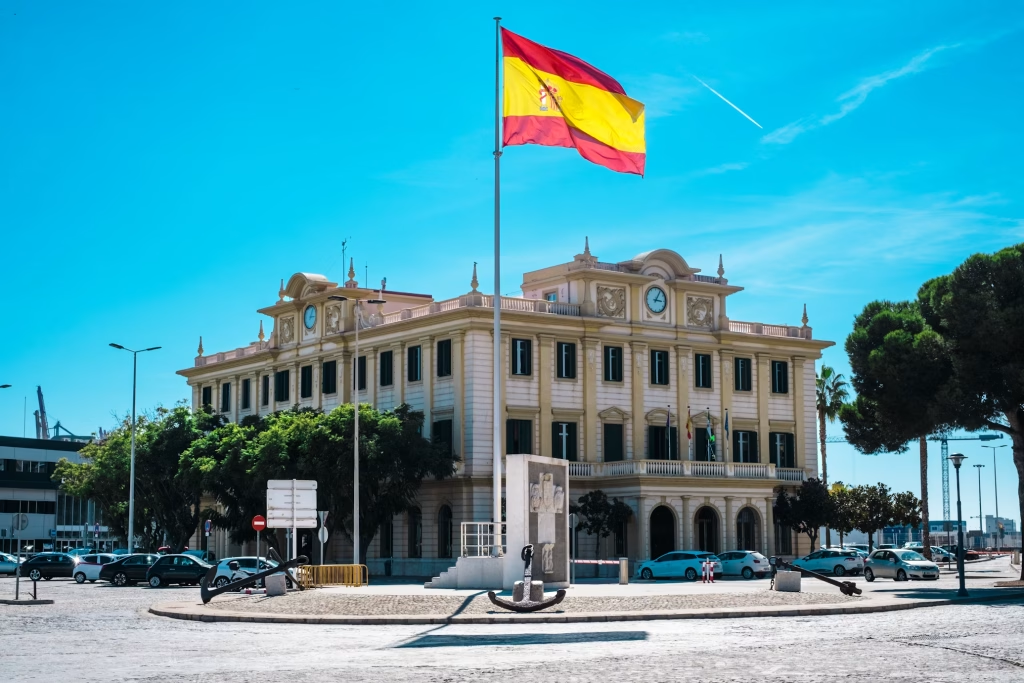
Spain has become the first country to openly declare its intentions in what is shaping up to be one of the most consequential leadership contests in European economic governance. The country’s economy ministry said on Wednesday that Madrid would “actively work to ensure it holds an influential and meaningful position” at the European Central Bank, adding that Spain seeks “a leadership role within Europe’s main economic institutions.”
The statement, from Economy Minister Carlos Cuerpo, marks the first time any eurozone government has publicly staked its claim to the ECB presidency since speculation over Christine Lagarde’s departure intensified this week. It is a calculated move — and one that immediately reframes the succession from a quiet diplomatic process into an open political contest.
Why Now?
The timing is no accident. On the same day Spain made its announcement, the Financial Times reported that Lagarde is expected to step down before her eight-year term ends in October 2027. The move would allow outgoing French President Emmanuel Macron and German Chancellor Friedrich Merz to oversee the appointment of her successor The Irish Times — crucially, before French presidential elections in April 2027 that could bring Marine Le Pen’s far-right National Rally to power for the first time.
The ECB responded by saying that Lagarde remains focused on her mission and has not taken any decision regarding the end of her term. Euronews Bank of France Governor François Villeroy de Galhau dismissed the reports as a rumour. Euronews But the political machinery is already turning. Villeroy himself recently announced his own early departure from the Bank of France, a move that ensures Macron rather than a potential far-right successor controls that appointment too.
For Spain, the window is narrow and the logic is clear: if the succession process begins now, Madrid has leverage. If it waits, the deal may be done without it.
Spain’s Candidate
While the economy ministry stopped short of formally nominating anyone, the candidate is no secret. Cuerpo described former Bank of Spain governor Pablo Hernández de Cos as an “excellent professional” with a career that is “more than proven,” enjoying the recognition of his peers. European Newsroom
Hernández de Cos served as governor of the Bank of Spain from 2018 to 2024 and currently leads the Bank for International Settlements in Basel. An FT poll of European economists in December placed him alongside former Dutch central bank chief Klaas Knot as the most likely successor to Lagarde. Euronews Bloomberg analysts have reached similar conclusions, viewing the pair as established frontrunners.
His profile suits the moment. He is a technocrat rather than a politician, which matters for an institution that jealously guards its independence. He brings direct eurozone central banking experience at the highest level. And he represents Europe’s fourth-largest economy — a country that has never held the ECB presidency despite being the bloc’s fastest-growing major economy in recent years.
The Competition
Spain’s public declaration is designed to force the pace, but it is far from the only contender. Klaas Knot is increasingly viewed as a consensus candidate — a former hawk who has moderated into a more centrist, coalition-building figure. Advisor Perspectives He is particularly attractive to Berlin, where Chancellor Merz may prefer backing a like-minded Dutchman over the political complexity of nominating a German.
Germany’s own ambitions are complicated by the fact that European Commission President Ursula von der Leyen is German and her term runs until 2029. Advisor Perspectives Having both the Commission and the ECB led by Germans simultaneously would be a hard sell to other member states. Still, both Bundesbank President Joachim Nagel and ECB Executive Board member Isabel Schnabel have signalled interest.
France, having held the presidency twice in succession with Jean-Claude Trichet and Lagarde, is widely expected to step aside this time, though Paris will want something in return — possibly the ECB chief economist role when Philip Lane’s term expires in May 2027.
The Bigger Game
The ECB presidency is never decided in isolation. It is part of a broader package of appointments across European institutions, negotiated behind closed doors by heads of state. Four of the six members of the ECB Executive Board will see their terms expire by the end of 2027 MarketScreener, including Lagarde, Lane, and Schnabel. That means three or four seats on the most powerful economic body in Europe will be reshuffled simultaneously — creating a complex negotiation where countries trade positions across institutions.
Spain’s public move is as much about signalling as it is about any single candidate. By being first to declare, Madrid is establishing itself as a serious player in a negotiation that will ultimately involve Germany, France, Italy, and the Netherlands at a minimum. Cuerpo’s statement that Spain “will not lack excellent candidates” is diplomatic language for something blunter: we want the top job, and we expect to be at the table.
What It Means for Markets
For now, the practical impact is limited. Nomura economist Andrzej Szczepaniak noted that the ECB takes monetary policy decisions by consensus, and whoever replaces Lagarde is unlikely to radically shift the institution’s direction. Advisor Perspectives Inflation is expected to hover near 2%, and the policy path is relatively well telegraphed.
But the identity of the next ECB president matters beyond rate decisions. It will determine how the institution navigates Europe’s energy transition, its response to the next recession, and its role in the increasingly politicised debate over European sovereignty. Spain is betting that its moment has arrived. The question now is whether the rest of Europe agrees.
The post Spain Makes Its Move for the ECB Presidency — The Race Is Now On appeared first on European Business & Finance Magazine.