






















Orbán’s Allies Are Cashing Out Before the New Government Arrives in Hungary
EBM Newsdesk Analysis
Hungary’s business elite are systematically distancing themselves from Viktor Orbán’s network of power, with senior figures relocating assets abroad, ringfencing exposure to politically-connected entities, and in some cases publicly pledging cooperation with incoming Prime Minister Péter Magyar — whose Tisza Party won a constitutional supermajority of 141 seats in the 12 April 2026 parliamentary elections, ending Orbán’s 16-year hold on power. The shift is not entirely surprising in scale, but the speed and openness with which it is unfolding marks a structural break from the Hungarian political-economic norm. For a system built explicitly on patronage relationships between Fidesz and a hand-picked business caste, the rapid abandonment of the Orbán network by its own beneficiaries is the clearest evidence yet that the patronal system has collapsed faster than its political defeat suggested.
The deeper read is that Hungarian capital has reached a verdict on the post-Orbán environment well ahead of the formal transition of power. The European Commission is preparing to release up to €17 billion in previously frozen EU funds to Budapest within weeks, conditional on Magyar’s government reversing rule-of-law violations under Orbán. That money — equivalent to roughly 8% of Hungarian GDP — is the single largest fiscal stimulus any incoming European government has received in two decades, and it tells the business elite everything they need to know about which political alignment will define commercial opportunity over the next five years.
What “Distancing” Actually Looks Like
The mechanics of Hungarian business elite repositioning are following three identifiable patterns. The first is geographic: senior figures associated with Fidesz patronage networks are physically relocating to Vienna, Zurich, Luxembourg and London, in many cases moving family residences and primary tax domicile in parallel with the political transition. The second is structural: ringfencing of Hungarian assets through restructured ownership vehicles, often involving the transfer of beneficial ownership to non-Hungarian intermediate holding companies. The third is reputational: targeted distancing from publicly-known Fidesz connections through resignations from advisory boards, severance of consultancy arrangements, and in some high-profile cases, direct outreach to the incoming Tisza administration offering cooperation.
The pattern is significant because it represents a systematic recalibration by the cohort that benefited most from Orbán’s 16-year tenure. Hungarian business elites who built their fortunes inside the Fidesz patronage system understand better than any outside observer how rapidly state contracts, regulatory protection, and procurement preferences can be withdrawn when political alignment shifts. Their behaviour now is the most reliable indicator of what they expect from the Magyar government.
The €17 Billion Question
The European Commission’s frozen funds are the central commercial fact in this transition. Brussels has held back the disbursements since 2022 over rule-of-law concerns, judicial independence violations, and procurement integrity failures under Orbán. The Magyar government, with constitutional supermajority and an explicit anti-corruption mandate, will be able to satisfy Commission conditions within months. The €17 billion will then flow.
Where that capital lands is the commercial story of the next 36 months. EU funds at this scale historically flow through procurement processes that benefit a relatively narrow set of contractors with demonstrated capacity to absorb large public contracts — engineering firms, infrastructure builders, IT integrators, energy and utilities operators. The Hungarian companies positioned to receive the bulk of this capital will not be the same companies that received Orbán-era state contracts. Magyar has campaigned explicitly on dismantling procurement networks built around Fidesz loyalty. The reallocation of state contracts will produce a new generation of Hungarian commercial winners, most of whom are quietly positioning themselves now.
The Foreign Investor Read
For European institutional investors, the Hungarian transition is the most strategically significant Central European political shift since the 2015 Polish elections. Three implications matter immediately.
First, Hungarian sovereign and corporate debt risk premia should compress materially as the EU funds flow and rule-of-law conditions improve. Hungary’s borrowing costs have carried an “Orbán premium” for years; that premium will erode through 2026.
Second, M&A activity in Hungary should accelerate sharply as foreign acquirers re-enter a market they had largely avoided under Orbán’s economic nationalism. Sectors most likely to see foreign capital arrive: banking, telecoms, energy distribution, and consumer retail — all industries where Orbán-era policy actively discouraged foreign ownership.
Third, the Hungarian forint has already strengthened significantly in the weeks following the election. That trajectory is likely to continue through 2026 as international confidence rebuilds and EU fund inflows support the currency.
What Magyar Inherits
The Tisza government takes office with significant structural advantages — constitutional supermajority, EU funds incoming, broad public mandate, and a defeated political opposition — but also with material commercial liabilities. Hungary’s economy has been one of the worst-performing in the EU through 2024 and 2025, partly due to Orbán’s confrontational approach to Brussels and partly due to inflation and currency pressures that monetary policy has struggled to contain. Public debt is elevated. Several state-owned enterprises require recapitalisation. The healthcare and education systems require substantial investment.
Magyar’s economic team — drawing on figures including former Shell executive István Kapitány and former diplomat Orbán Anita — is signalling pragmatic, pro-European, pro-investment policy direction. The early commercial actions to watch will be the structure of EU fund deployment, the approach to Hungarian state-owned banks, and any signalling on the foreign ownership rules Orbán used to exclude European capital from key sectors.
The Wider European Read
Hungary’s transition has implications that extend well beyond Budapest. The €17 billion EU disbursement removes Orbán’s veto on Ukrainian aid, opening the path for a €90 billion EU loan to Kyiv that had been blocked. The end of the Orbán-Trump political alignment removes the most direct organisational link between European far-right movements and the US MAGA network. And the demonstrable failure of the illiberal economic model in Hungary — poor growth, capital flight, frozen EU funds — narrows the political space available for similar movements elsewhere in Central Europe.
For European business journalism, this is the structural realignment story of 2026. The smart money has already moved. The smart commentary should be catching up to it.
Related Analysis
- Why French Industrial Policy Is Outperforming Germany’s
- Europe’s $24 Trillion Breakup With Visa and Mastercard Has Begun
- The Strategic Implications of EU Capital Markets Union for Central Europe
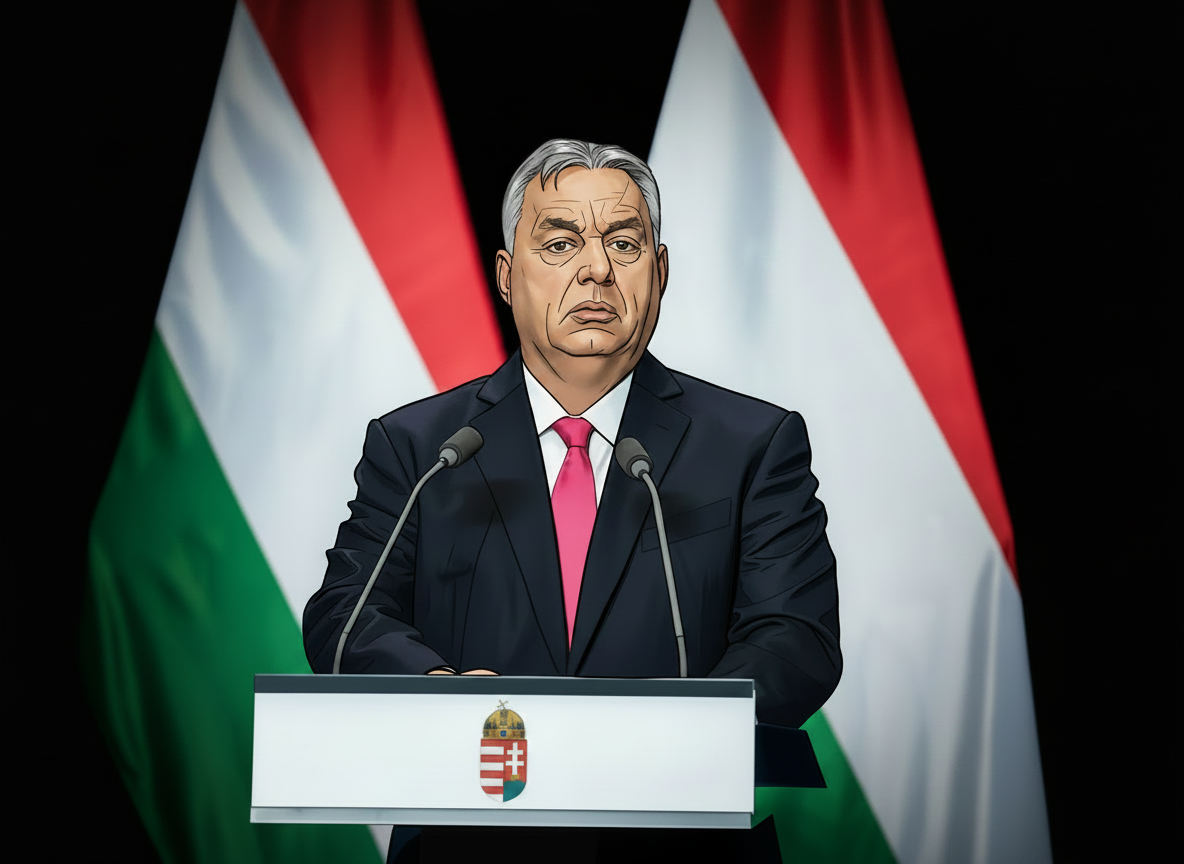
Photo Credit – AI-generated illustration / EBM Studio
The post Orbán’s Allies Are Cashing Out Before the New Government Arrives in Hungary appeared first on European Business Magazine.