
























Orbán Holds €90 Billion Ukraine Aid Hostage — Angry EU Leaders Confront Hungary in Brussels
- Quick Answer: EU leaders gathered at a Brussels summit on Thursday to pile pressure on Hungarian Prime Minister Viktor Orbán to lift his blockade on a €90 billion loan to Ukraine — a package agreed unanimously at an EU summit in December that Orbán has since reversed. Orbán is linking his veto to the restoration of Russian oil flows through the Druzhba pipeline, which was damaged by a Russian strike in January. With Kyiv at risk of running out of money in weeks, EU High Representative Kaja Kallas warned that “alternatives” would be explored if the veto is not lifted.
Orbán Is Holding a €90 Billion Ukraine Lifeline Hostage. The Rest of Europe Has Had Enough.
The Brussels summit that opened on Thursday was supposed to be about competitiveness, the single market and the next EU budget. Instead it has been consumed by a crisis of a different kind — one that goes to the heart of what the European Union actually is and whether a single member state can indefinitely veto the collective security interests of twenty-six others.
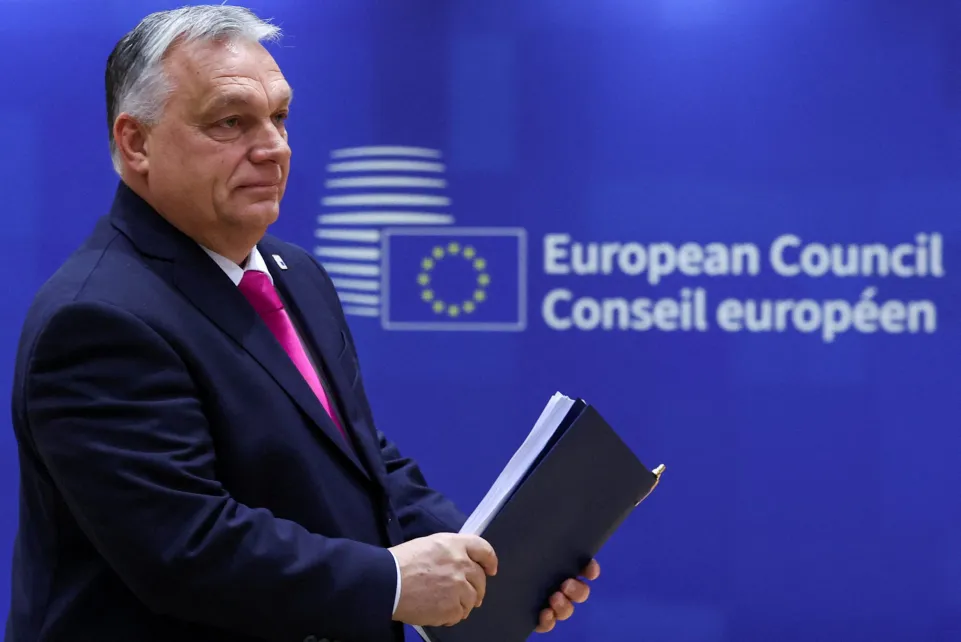
EU leaders arrived in Brussels with a unified message for Viktor Orbán: the €90 billion Ukraine loan agreed in December must be released. “We have to be clear: Hungary’s veto is unacceptable,” said Dutch Prime Minister Rob Jetten. Finnish Prime Minister Petteri Orpo was sharper still, accusing Orbán of using Ukraine as a weapon in his domestic election campaign. “He’s using Ukraine as a weapon in his election campaign, and it’s not good,” Orpo said. Orbán, arriving at the summit, showed no sign of movement. “We are waiting for the oil, the rest is fairytales,” he told reporters.
The Pipeline at the Centre of Everything
The immediate trigger for Orbán’s blockade is the Druzhba pipeline — the Soviet-era infrastructure that carries Russian oil through Ukraine to Hungary and Slovakia. A Russian missile strike near the Ukrainian town of Brody in January severely damaged critical pumping equipment, rendering the pipeline inoperable. Orbán insists Ukraine is deliberately delaying repairs for political reasons, timed to disadvantage him before Hungary’s April 12 elections. Kyiv denies this. The EU has offered Ukraine technical support and funding to fix the pipeline, and Zelenskyy has agreed to accept it — a concession that other EU leaders are pointing to as grounds for Orbán to drop his opposition.
The strategic cynicism of Orbán’s position has provoked particular fury among fellow leaders because Hungary secured an opt-out from paying for the costs of the loan alongside the Czech Republic and Slovakia — meaning Budapest faces no financial exposure from the package it is now blocking. As European Parliament President Roberta Metsola put it: “If you say that you will commit to something, then that needs to be followed through.”
Ukraine’s Narrowing Window
The stakes extend well beyond the Brussels summit chamber. Ukraine could run out of money in early May without a first tranche of the €90 billion loan, and Kyiv is simultaneously approaching reform deadlines tied to separate World Bank and IMF tranches. The financial pressure on Kyiv is compounding at precisely the moment when the Middle East conflict is distracting Washington and US-brokered Russia-Ukraine peace talks have effectively stalled.
High Representative Kaja Kallas was uncharacteristically blunt about her expectations. “I’m not very optimistic about lifting the veto during the summit,” she said, pointing to the ongoing pipeline dispute as an unresolved precondition for any Hungarian movement. She said there were “alternatives” if the loan fell apart — but did not specify what those were, beyond urging leaders to show “political courage.”
The Bypass Question
Several EU member states have quietly raised the possibility of routing the loan through qualified majority voting mechanisms — bypassing the unanimity requirement that gives Orbán his veto. German Chancellor Friedrich Merz called on the EU to stop allowing a single country to hold Europe’s security interests hostage for domestic political reasons. Brussels is also examining “enhanced cooperation” procedures that would allow a majority of member states to move forward without unanimous consent.
The problem is precedent. Using procedural mechanisms to bypass a member state veto — even one as nakedly opportunistic as Orbán’s — sets a template that other governments could exploit in future. The EU’s merger reform agenda, its competitiveness programme and its broader single market integration push all depend on the principle of good-faith cooperation between member states. Each time that principle is tested — and each time the EU reaches for a procedural workaround — the institutional architecture becomes slightly more fragile.
Slovak Prime Minister Robert Fico has already signalled he may maintain the blockade even if Orbán loses the April election — meaning the problem may not be resolved by the ballot box. The EU’s €90 billion bet on Ukraine’s future is currently being held hostage not just by one election, but by a political dynamic that could survive it.
Orbán’s position, stripped of the pipeline pretext, is straightforward: he is running an election campaign on the premise that he alone stands between Hungary and a war Europe is dragging it into. Releasing €90 billion to Ukraine ends that argument. He has no electoral incentive to move — and every incentive to hold.
The post Orbán Holds €90 Billion Ukraine Aid Hostage — Angry EU Leaders Confront Hungary in Brussels appeared first on European Business & Finance Magazine.