




















Chinese Automakers Race the Clock as EU Prepares to Tighten Foreign Investment Rules
EBM NEWSDESK ANALYSIS-Nick Staunton
BYD, Chery, Xpeng and SAIC are scrambling to lock down European factory space before Brussels closes the window. The race is reshaping Europe’s industrial map.
A Closing Door
Chinese electric vehicle and battery manufacturers are accelerating efforts to secure production capacity across Europe before a new EU industrial framework takes effect that could make future investment substantially harder. The European Commission has proposed an Industrial Acceleration Act explicitly designed to curb foreign direct investment that Brussels argues could threaten domestic industry and jobs. The draft rule has had an immediate and predictable effect: it has prompted Chinese carmakers to move faster, not slower.
The logic is straightforward. Securing a foothold — land, permits, an operating licence, an existing facility — before new restrictions bite locks in market access that may simply not be available to apply for once the framework is in force. China’s automakers are treating the current window as a closing one, and behaving accordingly.
The Numbers Behind the Rush
The scale of the shift in Europe’s auto market is significant. China’s share of Western Europe’s car market reached 8.6% in the first quarter of 2026 — nearly double its share from the previous year. Chinese-backed battery and EV manufacturing investment in Europe surpassed €30 billion in 2026.
That growth has coincided with a sharp contraction in European manufacturers’ own fortunes. European vehicle sales fell from 15.3 million units in 2019 to below 13 million in 2025. Declining demand has left Volkswagen, Ford, Nissan and Stellantis sitting on significant excess manufacturing capacity — plants built for a market that no longer exists at the scale it once did.
Using Europe’s Own Surplus Against It
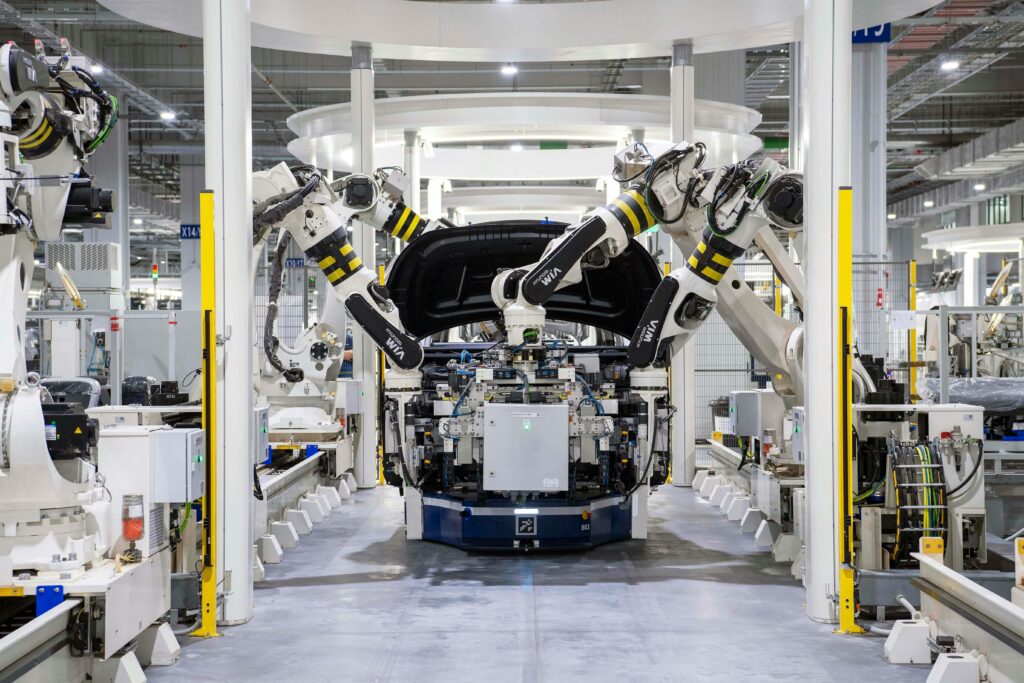
The most striking element of the current rush is not new greenfield construction. It is Chinese automakers buying or leasing the very excess capacity that European manufacturers are trying to offload. GAC Group has begun EV assembly at Magna’s Graz facility in Austria. SAIC Motor’s MG brand has reportedly narrowed its European site search to five locations, with Spain now emerging as the likely choice — not a new build, but a takeover of an existing facility currently operated in a different industry.
Nissan is reportedly in discussions with Chery over manufacturing cooperation in the UK. Ford and Stellantis have separately explored similar partnerships in Spain. The pattern is consistent: Chinese OEMs are finding it faster and cheaper to absorb idle European capacity than to build from scratch, while struggling European manufacturers find a willing buyer for assets they no longer need.
Not every search has gone smoothly. Xpeng’s managing director for north-eastern Europe, Elvis Cheng, candidly noted that one available Volkswagen plant under consideration was, in his words, “a little bit old” — a reminder that even motivated buyers have standards, and that not all available European capacity is fit for modern EV production without significant retrofitting investment.
The Turkey Warning
Not every Chinese commitment to invest in Europe has translated into delivery, and that history is shaping how seriously the current rush is taken in some quarters. BYD secured import tariff exemptions in Turkey in exchange for a commitment to build a local plant. Production was scheduled to begin in 2026. Construction has reportedly not yet started, prompting calls within Turkish political circles for sanctions and financial penalties.
That precedent matters for the European Commission as it finalises its own framework. If commitments to invest can be used to extract favourable terms — tariff exemptions, market access — without a corresponding obligation to actually build on the agreed timeline, the leverage runs entirely in one direction. The Industrial Acceleration Act is, in part, an attempt to close that gap before it becomes a structural feature of EU-China industrial relations.
What the New Rules Are Likely to Require
Policy analysis from Bruegel and the Rhodium Group has consistently flagged the same gap in Europe’s existing investment-screening regime: current foreign investment vetting was built to address acquisitions of existing European companies, not greenfield investment by foreign manufacturers building new capacity from the ground up. China’s EV makers have exploited precisely that gap.
Proposed remedies under discussion include requiring local-content commitments where Chinese inputs benefit from state subsidies, redirecting any recovered subsidy value into EU-managed funds for workforce development and research, and establishing clearer thresholds for when Brussels can intervene to assess market distortion. The Commission has signalled it wants to avoid blunt instruments — production caps or forced technology transfers — in favour of more targeted conditions attached to future investment approval.
The Strategic Tension
Europe’s position is genuinely difficult to resolve cleanly. Chinese investment is propping up jobs and absorbing excess capacity at struggling European plants that might otherwise face closure. It is also entrenching Chinese manufacturers inside the European market at a pace that domestic competitors cannot match, while raising legitimate questions about state subsidy, technology transfer and long-term market concentration.
The Industrial Acceleration Act will not resolve that tension. What it will do is end the current period in which Chinese automakers can secure market access on largely uncontested terms. The race now underway — BYD, Chery, Xpeng and SAIC all moving simultaneously to lock down sites — is the clearest evidence yet that the industry itself believes the window is closing, and that whatever is secured before the rules take effect will prove considerably more valuable than what comes after.
Related reads:
- Germany Backs France on US-Style Tariffs — EU Trade Strategy Shifts
- Saab: How Britain’s Carmaker Became a €27bn Defence Giant
- All Eyes on Warsh: Fed’s First Meeting Under New Chair
The post Chinese Automakers Race the Clock as EU Prepares to Tighten Foreign Investment Rules appeared first on European Business Magazine.