


































10 Austrian startups to keep an eye on in 2026 and beyond

Once again, it is that time of the year when we begin our annual series highlighting some of the most promising startups from across Europe. Each edition takes a country-by-country look at the teams and technologies shaping the continent’s entrepreneurial landscape. For 2026, we are starting with Austria, opening the series with a closer look at some of the most interesting young companies emerging from its capital city.
Vienna has steadily evolved into an active hub for innovation, supported by strong academic institutions, a well-connected talent base, and a growing community of founders building across sectors such as deep tech, climate technology, AI, and digital infrastructure. The city’s combination of research expertise and accessible support structures continues to attract companies developing both early-stage concepts and scalable commercial solutions.
In this article, we highlight 10 exceptionally promising startups based in Vienna that are worth keeping an eye on in 2026. They represent a mix of industries and technologies, reflecting the diversity and ambition driving Austria’s startup ecosystem forward.

Vienna-based Chatlyn is a company that develops an AI communication hub designed for the hospitality sector. Their platform centralises guest communication by bringing channels such as email, WhatsApp, Booking.com messages, Instagram DMs, and voice interactions into a single inbox. Chatlyn’s tools support translation in more than 35 languages, automated responses, and AI-driven assistance designed to streamline customer interactions.
Founded in 2022, the company has raised €8 million. It is used by more than 1,000 hospitality properties and integrates easily with property management systems such as Opera Cloud, Apaleo, Protel, and Mews. The aim is to help accommodation providers reduce manual communication tasks, improve response times, and enhance guest engagement through a more connected and efficient communication infrastructure.

Linz-based Emmi AI is a company that uses artificial intelligence to make engineering simulations much faster and easier. Instead of waiting hours or days for results, their technology can run complex tests in seconds, helping industries such as automotive, aerospace, and energy explore ideas and designs more quickly. Their models can handle very large simulations on a single graphics card, which reduces costs and removes many of the usual technical barriers engineers face.
Founded in 2024, the startup has raised €15 million in funding. Emmi AI works with research labs and global engineering teams, integrating their tools into existing software so companies do not need to change how they work. The aim is to help organisations speed up development, test more ideas, and make better decisions by giving them instant engineering insights.

Vienna-based Flinn is a company that helps medical device manufacturers automate complex regulatory and quality tasks. Their platform uses AI to support activities such as literature evaluation, safety database monitoring, regulatory tracking, and complaint handling. Companies can review information from multiple global databases at once, receive AI-assisted evaluations, and generate audit-ready reports with a single click.
Founded in 2022, the company has raised €9.8 million. Flinn is designed to help teams stay compliant with MDR and IVDR requirements while reducing the amount of manual work involved in maintaining documentation. It integrates with established regulatory workflows and offers validated documentation aligned with standards such as IEC 62304, ISO 13485, ISO 14971, and FDA 21 CFR Part 11.

Vienna-based fynk is a startup that provides contract management software designed to make it easier for teams to create, edit, review, and manage contracts in one place. The platform replaces scattered files and manual processes with a single system where users can draft documents, track versions, collect signatures, and set reminders for important deadlines.
Founded in 2022, the young company has raised €4.35 million. fynk uses AI to extract information from contracts, identify key details, and highlight potential issues automatically. The software is built for European businesses and includes GDPR-compliant data protection and audit-proof storage to keep contracts secure throughout their lifecycle.

Vienna-based Graph Therapeutics is a company developing precision medicine tools to better understand and treat immune-mediated diseases. Their approach combines data from patient cell samples with multi-omics information, allowing them to study how cells react to different conditions and identify the biological drivers behind complex illnesses. By using AI to analyse these reactions, Graph Therapeutics aims to find new targeted therapies and biomarkers that can support more accurate diagnosis and treatment.
Founded in 2024, the startup has raised €3.8 million, aiming to help clinicians personalise care by providing clearer insights into how a patient’s immune system behaves, ultimately improving outcomes for people living with chronic inflammatory and autoimmune conditions.

Vienna-based sequestra is a startup developing technology that turns industrial residues, such as steel slag, incineration ash, and construction waste, into usable construction materials that permanently store carbon dioxide. Their approach is based on accelerated carbonation technology, a process that binds captured CO₂ into mineral waste in a stable and long-lasting form.
Founded in 2024, the company has raised €1.1 million, aiming to support hard-to-abate industries in lowering emissions as carbon credit prices rise across Europe. Their work addresses both the climate challenge and the growing demand for low-carbon construction materials.

Vienna-based silana is a company developing technology to automate garment production, a process that is still almost entirely manual in the fashion industry. Their system uses robotics, artificial intelligence, and machine vision to sew clothing automatically, replacing the last major hand-crafted step in apparel manufacturing. By automating this process, silana aims to help brands produce garments closer to home, shorten production cycles, and reduce the need for large early orders that often lead to waste.
Founded in 2022, the startup has raised €2.82 million. silana’s technology is designed to address challenges such as labour shortages, long offshore supply chains, and the environmental impact associated with overproduction. Their system allows manufacturing to be relocated to regions with higher labour costs while remaining cost-efficient, helping fashion brands reduce emissions, improve responsiveness to demand, and minimise unsold inventory.

Vienna-based Syntropic Medical is a startup developing a non-invasive light-based treatment for depression. Their technology uses precise flickering light stimulation delivered through the eyes to activate immune cells in the brain, which may support neural repair and recovery. This approach aims to offer an alternative for people who do not respond well to traditional antidepressant medication or who experience side effects. The company is building a treatment that can be used safely at home, supported by clinical studies in collaboration with international research centres.
Founded in 2023, the young company has raised €2.4 million. They have completed first-in-human tests and are running feasibility studies in Brazil and the United States to evaluate the safety and usability of the device for patients with major depressive disorder. Their goal is to create a new option for mental health care that is practical, non-pharmaceutical, and accessible for people seeking alternative forms of treatment.
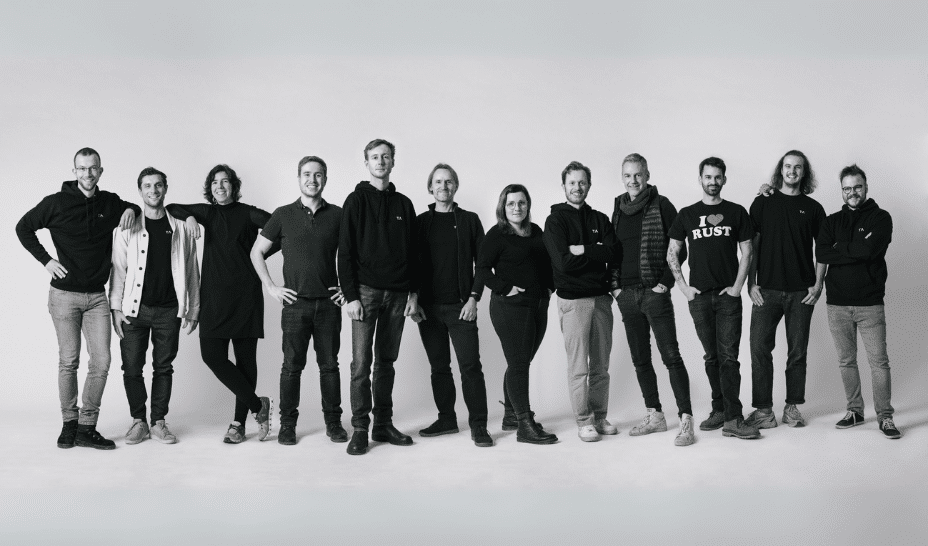
Graz-based TACEO is a fast-growing company developing technology that allows people and organisations to work together on encrypted data without revealing the underlying information. Their platform uses privacy-focused cryptographic techniques, such as secure multi-party computation and zero-knowledge proofs, to let users collaborate and verify results while keeping sensitive data confidential. This helps developers build applications where actions can be checked and trusted publicly, even though the data used to perform them remains private.
Founded in 2022, the startup has raised €5.2 million to create a network and set of tools designed for use cases such as private financial transactions, secure identity systems, and confidential data sharing in Web3 environments. The goal is to make privacy-preserving computation more practical and accessible for decentralised applications.

Vienna-based Teneo Protocol is a startup building a decentralised network that collects and organises real-time public data through community-run AI agents. Anyone can install the Teneo Community Node, which operates in the browser and gathers openly available information from the web. The aim is to create a shared data layer that users can contribute to and benefit from, without relying on expensive or restricted third-party platforms.
Founded in 2024, the young company has raised €2.6 million to provide a dashboard that allows users to track rewards, manage tasks, and interact with the network, while maintaining privacy by processing data locally on the user’s device. The platform is supported by partners in the decentralised technology ecosystem and is designed to make it easier for individuals and developers to access structured public data and contribute to a more open and distributed web infrastructure.
By the way: If you’re a corporate or investor looking for exciting startups in a specific market for a potential investment or acquisition, check out our Startup Sourcing Service!
The post 10 Austrian startups to keep an eye on in 2026 and beyond appeared first on EU-Startups.