























WEEKEND READ: Squash Is Finally Olympic. Now It Has a Monopoly Problem and It Lives in Cairo
EBM WEEKEND READ – By Nick Staunton, Editor-in-Chief
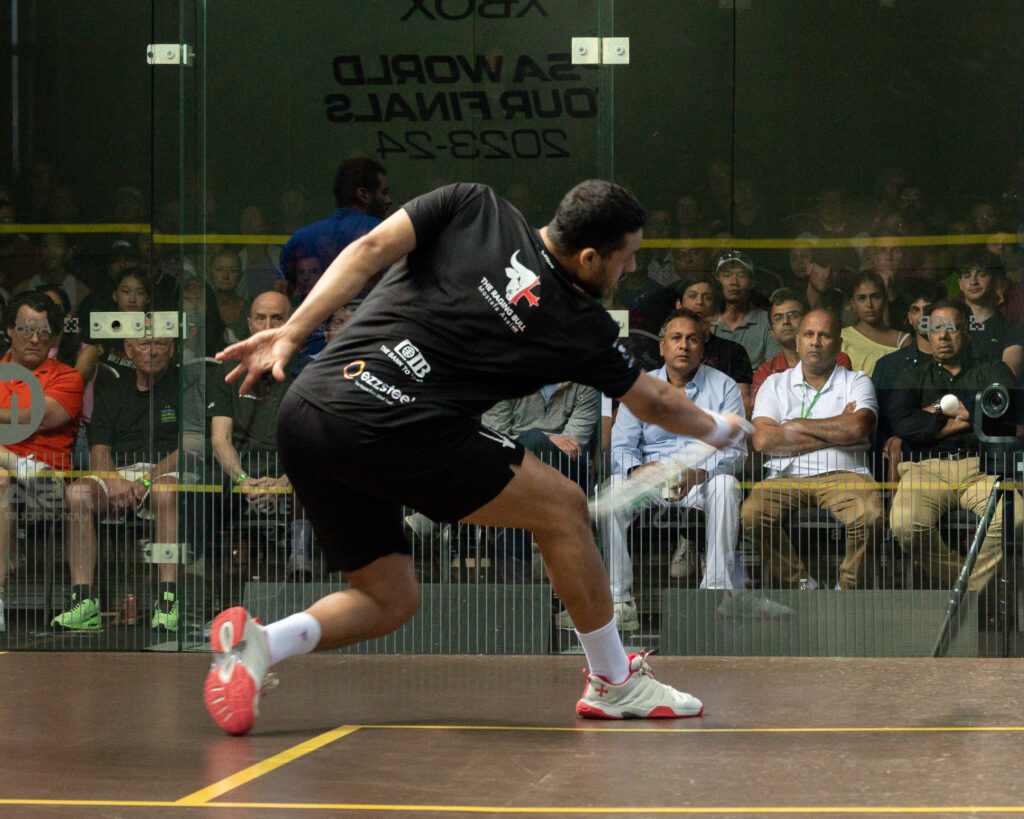
This weekend, the Birmingham Repertory Theatre hosts the final of the 87th Quilter Cheviot British Open — one of squash’s oldest and most prestigious titles, played on an all-glass showcourt in the heart of the Midlands. World number one Mostafa Asal arrives as top seed, fresh from winning his second consecutive men’s world title in Giza three weeks ago, with Diego Elias of Peru — the defending British Open champion who beat Asal in last year’s final — seeded third and ready to renew one of sport’s most compelling rivalries. On the women’s side, can the recently crowned 18-year-old world champion Amina Orfi do an encore?
It is, in microcosm, everything that makes squash both irresistible and commercially complicated right now. The best players on earth, competing at the highest level, in a city that has hosted this tournament for years — and almost all the names at the top of the draw share the same passport. On the eve of the sport’s first Olympic debut at LA 2028, with Comcast’s name above the court and $2.5 billion in sponsorship riding on the narrative, Birmingham this weekend is the perfect place to ask the question that the PSA cannot afford to ignore: when one nation wins everything, who exactly is the sport selling to the world?
The Sport That Waited 40 Years
 On the evening of 16 May in Giza, Egypt, squash delivered one of the most extraordinary results in its history. Eighteen-year-old Amina Orfi defeated eight-time world champion Nour El Sherbini 6-11, 11-6, 11-9, 7-11, 14-12 in a 106-minute final to become the youngest women’s world champion in the sport’s history — and the first player ever to hold the junior and senior world titles simultaneously. Hours later, Mostafa Asal retained the men’s crown in straight sets. Both finals all-Egyptian. Both played in Egypt. Both, in their different ways, the story of a nation that has turned a racket sport into a statement of national intent. The timing could not be more loaded. Squash’s inclusion in LA 2028 came after the sport had been rejected from the Olympic Games on four consecutive occasions. Four times the door shut. The fifth time it opened — and with it came commercial leverage the PSA had never possessed. The new athlete economy, as we have explored in our examination of how Ronaldo, LeBron and Mbappé are building investment empires that dwarf their playing salaries, is reshaping how sport is valued, sold and broadcast. Squash is now, for the first time, part of that conversation.
Comcast’s Bet and Its Egyptian Problem
The commercial infrastructure being assembled around squash’s Olympic debut is the most ambitious in the sport’s history. The Comcast Squash Center at Universal Studios became one of the first venues in Olympic history to carry corporate naming rights, as LA28 organisers targeted $2.5 billion in domestic sponsorship — the largest commercial revenue raise in sports. Squash Media & Marketing signed a five-year partnership with Two Circles to grow digital platforms, expand global media rights distribution and build structural audience intelligence ahead of the Games. The first deal delivered under that arrangement was a broadcast agreement with Foxtel’s Kayo Sports in Australia, bringing live PSA Tour coverage to one of the sport’s fastest-growing markets
 The ambition is real. So is the paradox sitting at the centre of it. Since 2003, Egyptian men have claimed the world championship title 14 times, with women’s champions emerging repeatedly from the same talent pipeline. The 2026 World Championships produced the logical conclusion of that dominance: both finals all-Egyptian, on home soil. A sport that sold the IOC on its global, diverse character is, in competitive reality, a one-country operation. It is the same tension we identified in our analysis of how pickleball went from backyard game to a $225 million Wall Street proposition — the gap between a sport’s commercial story and its structural reality has a habit of catching up with those selling the narrative.
The Rivalry That Gives the Sport Its Best Story
 Which makes Diego Elias more important to squash than his ranking alone suggests. The Peruvian — fluid where Asal is explosive, cerebral where the Egyptian is instinctive — is the sport’s most compelling argument against its own monopoly problem. In Cairo in 2024, Elias defeated Asal in the world championship final — in Egypt, in front of Egyptian crowds, beating the player who would go on to win the next two titles. The rivalry has since produced some of the best squash of the professional era. At the El Gouna International in April, Elias ended Asal’s winning run with a stunning comeback from 6-1 down in the deciding game across 93 minutes of play — only for Asal to avenge that defeat weeks later in the World Championship semi-final, winning in four games across 74 minutes of high-quality squash. Elias also claimed the 2025 British Open, defeating Asal in the final — in Birmingham, on European soil, in front of a crowd that understood it was watching something genuine.
That is the narrative Comcast needs. Power against precision. Egypt against the world. The reigning champion against the man who has beaten him on the sport’s biggest stages. The PSA would be commercially negligent not to build a significant portion of its Olympic broadcast strategy around this rivalry — much as the NBA understood, long before the analytics era, that its product needed a villain and a hero in every final. It is the same logic, as we noted in our profile of Michael Jordan’s $3.8 billion corporation, that turned a Chicago shooting guard into the most commercially powerful athlete in human history.
The 18-Year-Old Who Deepened the Problem
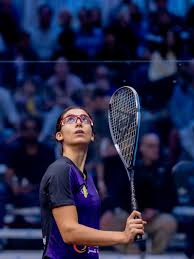 And then there is Orfi — simultaneously the most thrilling story in world squash and the starkest illustration of why Egypt’s dominance shows no sign of loosening. The Cairo native’s run to the world title came after several near-misses this season, including a loss to Nouran Gohar in the El Gouna International final and a five-set defeat to Japan’s Satomi Watanabe in Hong Kong. She overcame a public spat with world number one Hania El Hammamy during the season and used the surrounding drama as fuel, letting her racquet provide the answer. In the final itself, she saved two championship points in the deciding game before prevailing 14-12 — against a player who had won eight world titles and was chasing a record-breaking ninth. “I’m speechless,” Orfi said afterwards. “I worked so hard to get here and had so many tough losses this season.” She is not yet 19. She holds both the junior and senior world titles at the same time. And the next generation behind her, emerging from the same Cairo academies, is already ranked inside the world’s top 20. The pipeline does not pause.
The Factory Behind the Dynasty
 That pipeline deserves scrutiny, not least because European sports administrators would benefit from understanding what they have failed to build. The Wadi Degla Squash Academy alone operates with 2,000 players and 100 coaches, retaining world-class professionals on living salaries alongside a structured youth programme. Black Ball Sporting Club tracks players from under-11 through under-19 across five skill-based levels, with formal assessments every three months and specialist coaching at each stage. Government and private sponsorships have enabled players to compete globally while focusing entirely on their careers, sustained by a grassroots identification system running from school level upward. retreat elsewhere — as Egyptian squash strengthened, rivals declined, with children in Britain and other traditional squash nations simply taking up other sports instead. The same dynamic is playing out across multiple disciplines, as we explored in our examination of how Hyrox became a €200 million machine by capturing the fitness consumers that traditional sports lost — people with money, time and a desire for structured competition that legacy clubs failed to retain.
What LA 2028 Actually Needs
LA 2028 is the first Olympics to offer venue naming rights, with over $2 billion in sponsorships secured before 2026. The Games will air primarily in US prime time, with squash expected to open new audience segments for the IOC’s commercial partners alongside flag football and lacrosse.
Comcast’s naming rights investment is a bet on eyeballs — and eyeballs need drama. All-Egyptian draws in the early rounds of an Olympic debut do not hold a prime-time American audience encountering the sport for the first time. The qualification system offers some geographic mitigation: five athletes per gender will qualify via continental games, including the European Games in Istanbul in June 2027, with eight further places per gender allocated through PSA world rankings.
Istanbul- where the 2027 European Games will hand five Olympic qualification places per gender to the continent’s best players — is therefore a direct commercial opportunity for European federations to place players into the Olympic draw and give the sport the narrative breadth its sponsors require. Whether Europe has built the academy depth to take that opportunity is a serious question. Europe accounts for the largest projected share of the global squash market, with revenues forecast to reach $1.58 billion by 2033. The continent has the clubs, the urban fitness culture and the television infrastructure. What it has not built, to anything approaching Egypt’s scale, is the structured pathway from recreational player to world-ranked professional — the same gap, at a different price point, that we examined in our report on why the NBA’s European expansion has become a serious billion-dollar proposition and the continent’s persistent failure to convert sports enthusiasm into elite production systems.
The Verdict
Three weeks ago in Giza, squash gave the world two extraordinary stories in a single evening. A 25-year-old world number one retaining his title with clinical authority. An 18-year-old saving championship points in a fifth game to rewrite the record books. Both Egyptian. Both products of the same remarkable development system. Both, commercially speaking, a problem and an opportunity in the same breath.
The PSA has until July 2028 to ensure that Elias — and players like him — feature prominently enough in the Olympic narrative that Comcast gets the global sporting drama it paid for. That means broadcast storytelling built around the Asal-Elias rivalry, qualification pathways that reward geographic spread, and investment in federations outside Cairo. The lessons are available. Whether the sport takes them is another matter entirely.
Squash spent four decades being told it was not Olympic material. The harder problem, as anyone who has followed how Clarkson’s Farm became the most unlikely business story in British agriculture will recognise, is that the most disruptive stories rarely end where you expect them to.
The Third Problem Nobody Wants to Talk About
Egypt’s monopoly and the broadcast diversity gap are the two problems squash’s administrators discuss openly. There is a third, which they tend to discuss rather less: the refereeing.Any regular viewer of the PSA Tour will be familiar with the experience. A match reaches its critical juncture. A stroke or let decision lands. Players argue, crowds react, momentum evaporates and the broadcasters cut to a replay that answers precisely nothing, because the decision itself is inherently, structurally subjective. The let and stroke system — requiring a referee to make split-second judgements about intent, access and interference in a sport played at extraordinary speed — produces inconsistency at the highest level that no amount of training fully resolves. Referee decisions in squash are very subjective in nature, and disputes from both players and the audience regularly occur because of controversial calls. Researchers attempting to model these decisions using machine learning found the task genuinely difficult — not because the data was poor, but because the decisions themselves resist objective classification.
The commercial consequences of that subjectivity were made viscerally clear at the El Gouna International in April. After referee Andrea Santamaria administered a stroke against Asal for unnecessary physical contact and a further conduct stroke for an accumulation of movement offences — decisions that directly contributed to Elias winning the match — Santamaria was subjected to a physical threat from a spectator in the aftermath. The incident came shortly after a separate controversy in which a tournament sponsor had publicly voiced his opinion at officials. The WSO condemned the behaviour unreservedly and stood fully behind its referee. But the damage was done — not just to Santamaria personally, but to the image of a sport asking a global audience to trust it.
This matters commercially in a way that the PSA cannot afford to underestimate heading into LA 2028. Comcast did not put its name above a squash court in Hollywood for matches that end in crowd confrontations and disputed conduct strokes. Sponsors do not build primetime narratives around a sport where the most-discussed moment of a match is a referee decision that a significant portion of the audience believes was wrong. Tennis solved a version of this problem with Hawk-Eye. Cricket solved it with DRS. Both sports now route controversial decisions through technology that gives audiences — and players — a definitive answer. The result is not just fairer sport. It is better television.
Squash has no equivalent. The sport’s governing bodies have discussed the possibility of video review systems for years. The technology exists. The will to implement it at scale, and to fund it across the breadth of the PSA Tour, has not yet materialised. With two years until the sport’s most important commercial moment, that gap is no longer merely a sporting inconvenience. It is a broadcast liability — and one that the Comcast deal, the Two Circles partnership and the entire LA 2028 commercial apparatus cannot paper over if referees remain visibly exposed, decisions remain publicly contested and crowds in Egypt continue to believe that the result of a squash match is a matter of national honour rather than sporting competition.
The sport’s administrators have solved the hardest problem — forty years of Olympic rejection. The easier ones are running out of time.
RELATED READS:
1. WEEKEND READ: The Athlete-as-Hedge-Fund: How Ronaldo, LeBron and Mbappé Are Building Empires That Will Outlast Their Careers The new athlete economy is reshaping how wealth is created at the top of professional sport — and the playing career is merely the marketing budget.
2. WEEKEND READ: How Pickleball Went From Backyard Game to a $225 Million Wall Street Proposition The fastest-growing sport in America has attracted private equity, celebrity investors and a broadcast war. Sound familiar?
3. WEEKEND READ: Why the NBA’s European Expansion Has Become a Serious Billion-Dollar Proposition The league played two regular season games in Paris. Both sold out in under an hour. The commercial logic of what comes next is becoming impossible to ignore.
The post WEEKEND READ: Squash Is Finally Olympic. Now It Has a Monopoly Problem and It Lives in Cairo appeared first on European Business Magazine.