


























Ten Years After Brexit, the Question Is No Longer If Britain Returns to the EU — But When

- EBM Weekend Read — By Nick Staunton, Editor-in-Chief
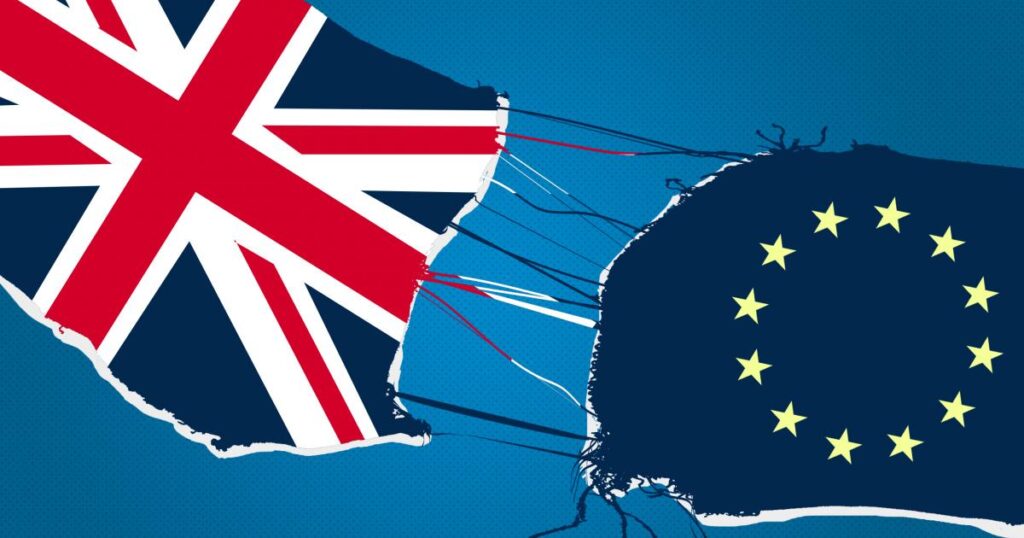
A decade after the referendum that reshaped Britain’s economic trajectory, a sitting Treasury minister has said out loud what an increasing number of senior Labour figures have been thinking privately for months. Speaking from the despatch box in the House of Lords on the tenth anniversary of the Brexit vote, Lord Spencer Livermore, Financial Secretary to the Treasury, departed sharply from official government policy. “My personal view is that that is an inevitability. Of course, the UK will at one point re-enter the EU because it’s absolutely in our national economic interest.”
The statement was immediately qualified as a personal opinion rather than government policy. It will not survive as such. In British politics, Treasury ministers do not freelance on questions of this magnitude without consequence — and the consequences of this particular remark will take some time to fully play out. But the direction of travel it signals, combined with the broader political context surrounding it, matters enormously for British business planning over the next decade.
The Political Context: Labour’s Positions Are Shifting
Lord Livermore’s remarks did not emerge in a vacuum. He is not the only senior Labour figure to start talking about closer ties with Europe in recent weeks. Former health secretary Wes Streeting called Brexit a “catastrophic mistake” and said Britain’s future “lies with Europe — and one day back in the European Union.” Andy Burnham said he wants Britain to rejoin the EU “in my lifetime.”
These remarks go far beyond the commitment made in Labour’s 2024 manifesto, which ruled out a return to the EU’s single market and customs union, let alone full membership. The gap between the manifesto position and the public statements of senior figures is now significant enough to constitute a political story in its own right — and British business is watching it carefully.
A YouGov poll published in April 2026 shows 55% of Britons now support rejoining the EU — a majority that has been building steadily as the economic costs of Brexit have become more tangible and more widely understood. Public opinion has shifted. The question is whether political leadership follows, and on what timeline.
The honest answer is that nobody can say with precision. Experts warn that EU member states would approach any UK accession talks with significant caution, mindful of the possibility of a Reform UK government in 2029 that would reverse course again. “The EU will be treating us with great caution,” one analyst noted. Brussels has no appetite for a repeat of the decade it spent managing Britain’s exit. Any re-entry process would be slower, more conditional and more politically fraught than the original membership ever was.
The Economic Cost That Is Driving the Conversation
The commercial case for the shift in language is not hard to find. The Office for Budget Responsibility projected in July 2025 that both UK exports and imports will be around 15% lower in the long run than they would have been had Britain remained in the EU. That figure sits at the heart of every serious analysis of British economic underperformance since 2016 — and it is a number that compounds annually. BitMEX
For British businesses, particularly those in manufacturing, financial services, professional services and agriculture, the practical consequences have been concrete and cumulative. Exporters have faced non-tariff barriers — customs declarations, rules of origin requirements, conformity assessments — that add cost and friction to every transaction with European counterparties. Services firms have lost passporting rights that allowed them to operate freely across 27 member states. Agricultural businesses have faced new sanitary and phytosanitary checks that have disrupted supply chains and increased costs on both sides of the Channel.
The European reset that the Labour government has been pursuing — closer alignment on defence, a youth mobility scheme, reduced friction on food and agricultural trade — addresses some of these frictions at the margin. But it does not restore the structural advantages of single market membership, and every business operating across the UK-EU border knows the difference.
What Rejoining Would Actually Mean for British Business
 The business case for EU membership is not straightforward to reconstruct — partly because the landscape has changed significantly since 2016, and partly because rejoining would not mean returning to the same arrangements Britain left.
Any UK re-accession would require negotiating entry on current EU terms. That means accepting the euro as the eventual currency target — though existing members with opt-outs demonstrate this is not immediate — and more significantly, accepting the full acquis communautaire, the body of EU law that Britain spent four years unwinding. The regulatory alignment that UK businesses would need to demonstrate to satisfy EU accession requirements would be a multi-year process of legislative convergence.
For financial services, the picture is the most complex. The City of London has adapted to life outside the EU’s financial regulatory framework — developing its own equivalence arrangements and in some cases building new infrastructure to serve European clients. Rejoining would bring back passporting rights but would also bring ECB oversight of systemically important institutions and potentially reduce the City’s ability to diverge from EU regulatory standards in areas where divergence has become a competitive advantage.
For manufacturing — particularly automotive, aerospace and pharmaceuticals — the case is more straightforwardly positive. Access to European supply chains without customs friction, recognition of regulatory standards without duplication and participation in EU research funding programmes like Horizon are all significant commercial benefits that full membership would restore.
As we explored in our analysis of how EU regulatory frameworks are reshaping the competitive landscape for European business, the single market is not simply a tariff-free zone. It is a regulatory architecture that creates common standards, common enforcement and a common legal framework for commercial disputes. British businesses that left it in 2020 have spent five years building workarounds. The cost of those workarounds — legal, operational and administrative — is rarely quantified publicly but is felt acutely by every company trading across the Channel.
The Timeline Question British Business Needs to Plan Around
The honest commercial assessment is this: full UK re-entry to the EU is not imminent, but the political direction of travel has shifted materially in the past six months and the business community needs to plan for a range of scenarios rather than assuming the current arrangements are permanent.
The earliest realistic window for any formal re-accession process would be after the next general election, which must be held by 2029. A Labour government returned with a mandate that included EU membership — or a coalition that made it a condition of cooperation — could begin formal talks within the subsequent parliament. Accession negotiations of this complexity rarely conclude in under five years. A realistic re-entry date, if the political decision is made in 2029-30, is therefore mid-to-late 2030s at the earliest.
 As we reported in our coverage of how the EU and UK’s diverging regulatory approaches are creating structural commercial challenges, the period between now and any re-accession would require British businesses to maintain dual compliance capability — managing both UK and EU regulatory requirements simultaneously. That is a cost. But it is also an insurance policy for businesses that want to be positioned for either outcome.
The smart money in British boardrooms is not betting on a specific timeline. It is investing in regulatory flexibility — maintaining EU-compliant product lines, preserving relationships with European regulatory counsel and avoiding infrastructure decisions that would be difficult to reverse if the political landscape changes.
Lord Livermore’s remarks from the despatch box will be walked back in their specifics by the time this article is read. But the direction they point in will not change. The conversation has started. And for British business, the time to start thinking seriously about what comes next is not when the politicians catch up — it is now.
Related Analysis
EU’s Competitiveness Drive Turns Green Transition on Its Head — The regulatory and industrial policy landscape reshaping European competitiveness — and the framework any returning UK government would need to align with.
Fico, the EU and the Russian LNG Hypocrisy — How diverging energy and trade policies between the UK and EU are creating structural commercial tensions that closer alignment would resolve.
Europe’s €24 Trillion Break With Visa and Mastercard — The scale of the European single market infrastructure that British financial services businesses lost access to in 2020 — and what restoration of that access would mean commercially.
The post Ten Years After Brexit, the Question Is No Longer If Britain Returns to the EU — But When appeared first on European Business Magazine.