






















Slovakia in Brussels drew red lines on the financing of the EU’s future agricultural policy
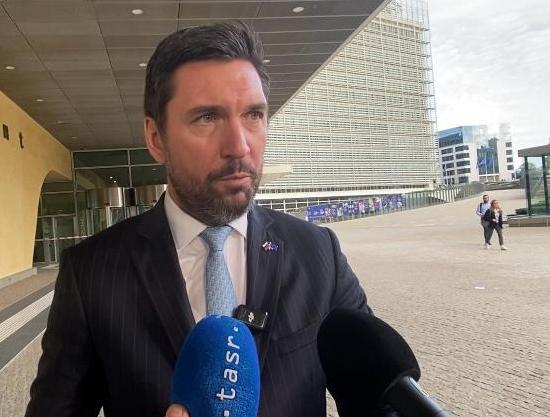
Brussels – There is still no agreement or satisfaction with the new common agricultural policy of the EU. This was stated on Wednesday evening in Brussels by the Slovak Minister of Agriculture Richard Takáč (Smer-SD) after a meeting of agriculture ministers from EU countries with three European Commissioners. The debates focused on the future of European agriculture and food security, the TASR correspondent reports.
Richard Takáč said that he sees Wednesday’s meeting as an exchange of political views on the future common agricultural policy and on agreements with third countries. He specified that the hastily convened meeting at the European Commission (EC) was due to protests by European farmers over the trade agreement with the Mercosur countries, and the agriculture ministers were given space to express their views on the financing of the common agricultural policy within the future multiannual financial framework.
“There is still no agreement or satisfaction with the new common agricultural policy. Even in the case of agreements with third countries there are questions, which is why we are still demanding some steps and solutions from the European Commission,” he explained.
He added that they did not talk only about Mercosur, because for Slovakia a bigger problem is the agreement with Ukraine and the very high quotas set for some commodities.
EC President Ursula von der Leyenová proposed before Wednesday’s meeting that the member states could draw some agricultural funds from the Union’s future long-term budget (2028 – 2034) earlier, in the amount of 45 billion euros. Takáč claims that the ministers “did not learn anything new” from her letter and that nothing extra is being offered to the agricultural sector.
“The President is only saying that we can draw earlier the money that is intended for us. We can move it elsewhere. But she is not saying that we will get more money, that we can be flexible. She is not saying that the common agricultural policy will be separate, that there will be a first and second pillar. It is such a hasty obfuscation, more like we pretend that we are doing something, but we are doing nothing,” he said.
According to him, however, the meeting was meaningful, because all the ministers expressed their position and “red lines” for their countries. He recalled that the ministers mostly say that the common agricultural policy must be separate and two-pillar.
Slovakia has three red lines: the two-pillar structure, better financing of the CAP and the return of the food industry to the common agricultural policy
He emphasized that for Slovakia there are three basic topics. First of all, the capping of direct payments, because Slovakia cannot suffer from having the most large farms, which is historically given. Then there is the issue of the allocation of financial resources, because after 20 years of EU membership Slovakia is at the level of 82% of direct payments compared to the old member states and external convergence is disappearing. Taking inflation into account, this means, according to Takáč, that Slovakia will have 20% fewer resources for the agricultural sector, which the Slovak government perceives sensitively when the EU wants to give one trillion euros more for armaments.
“Even today it was said by several ministers that we must be competitive and food self-sufficient, which is only possible if we have enough funding for the agricultural sector and if there is less bureaucracy,” he conveyed.
The third thing, important from Slovakia’s point of view, is that the food and wine sectors were excluded from the financing of agricultural policy and were moved to industry. For Slovakia it is very important that the food industry be included in the common agricultural policy.
With reference to trade agreements, Takáč pointed out that Slovakia is demanding that there be protective mechanisms for farmers in EU countries. In the case of Ukraine, Slovakia is calling for the establishment of a special fund that would compensate the agricultural sector if it suffers damage due to commodities from Ukraine.
“We all demanded, it was said there many times, that the standards that apply in the EU must be observed, in terms of limits for sprays, fertilizers, various preparations that are banned in the Union. The standards that European farmers and food producers must comply with must also be complied with by potential importers from third countries. We do not want postponements of two, three, four years. We demand that these things apply immediately when these agreements start to apply,” Takáč explained. (7 January)