























Oil Plunges 5% to $77 as Trump Signals Iran War Ending — But a New Shock Looms
Oil Just Crashed 5% in a Single Session — Here’s Exactly What Happened and What Comes Next
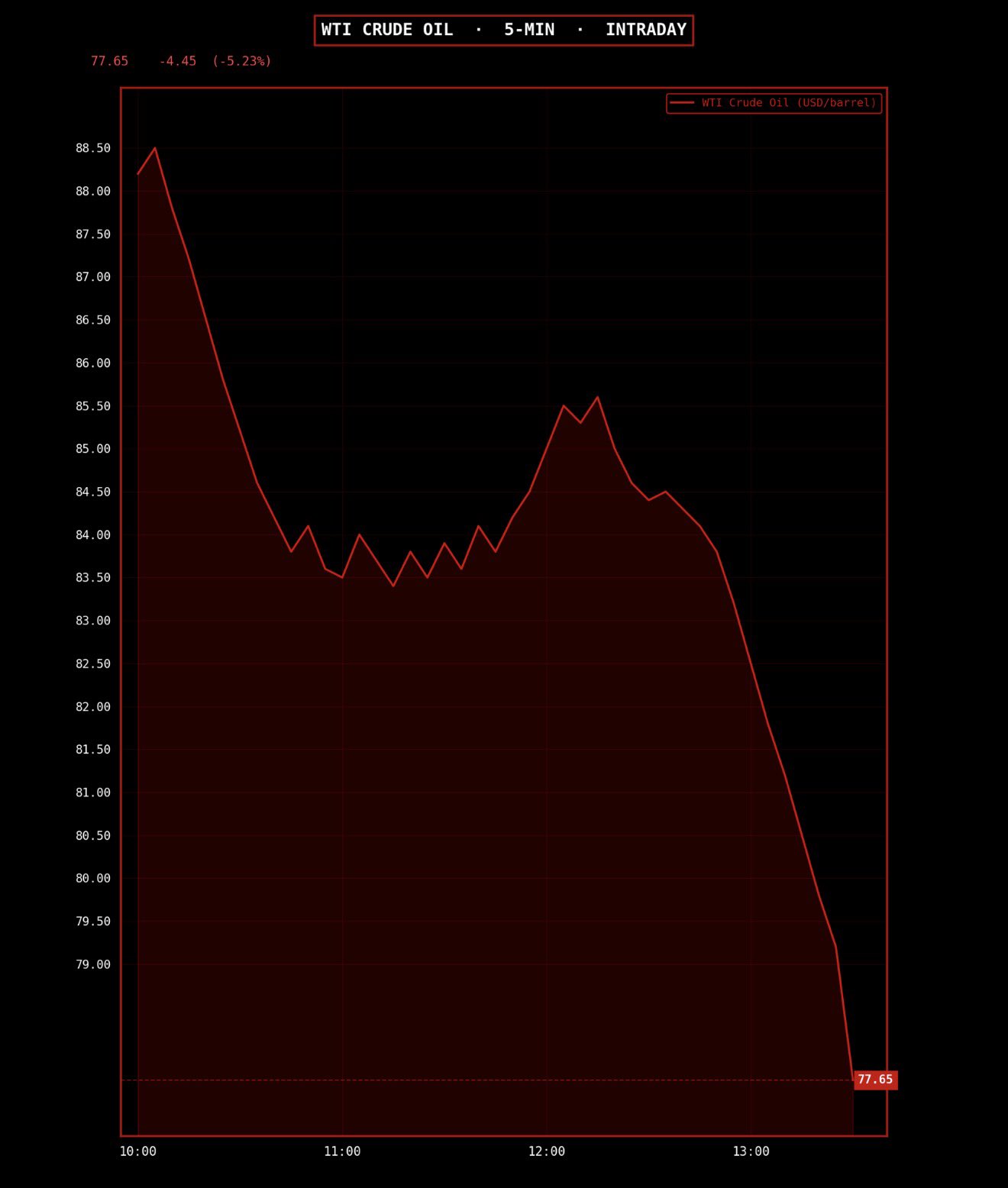
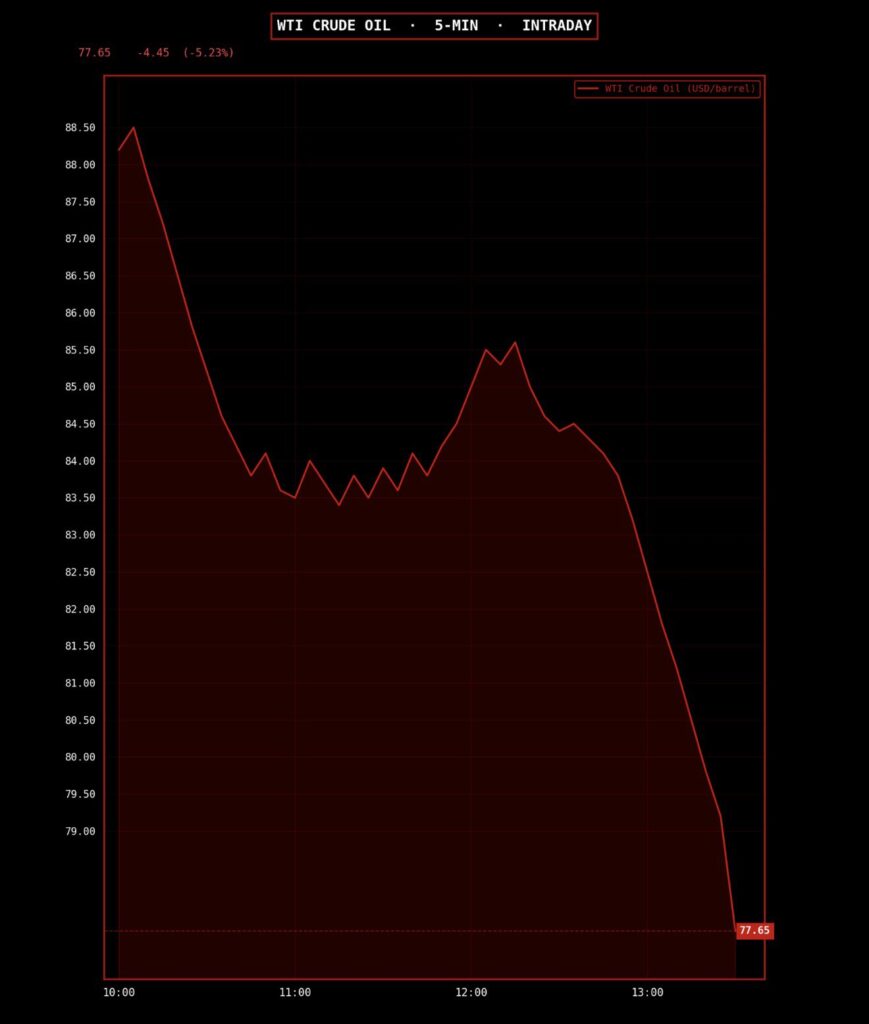
The oil chart that traders were staring at today told one of the most dramatic intraday stories in recent memory. WTI crude opened the session at $88.50 — already well below the $119.50 peak it hit just days ago — and proceeded to fall off a cliff, landing at $77.65 by early afternoon. A drop of $4.45, or 5.23%, in a single session. A market that had been pricing existential supply disruption just days ago is now questioning everything it thought it knew about how long this war lasts.
To understand why oil moved so violently today, you need to understand the extraordinary sequence of events — and contradictions — that played out in the space of a few hours.
What Actually Happened Today
The session started under pressure after Trump told CBS News that the Iran war was “very complete, pretty much” and running well ahead of schedule. Those comments — imprecise but directionally clear — had already knocked oil from its triple-digit peak earlier in the week. Today, the selling accelerated.
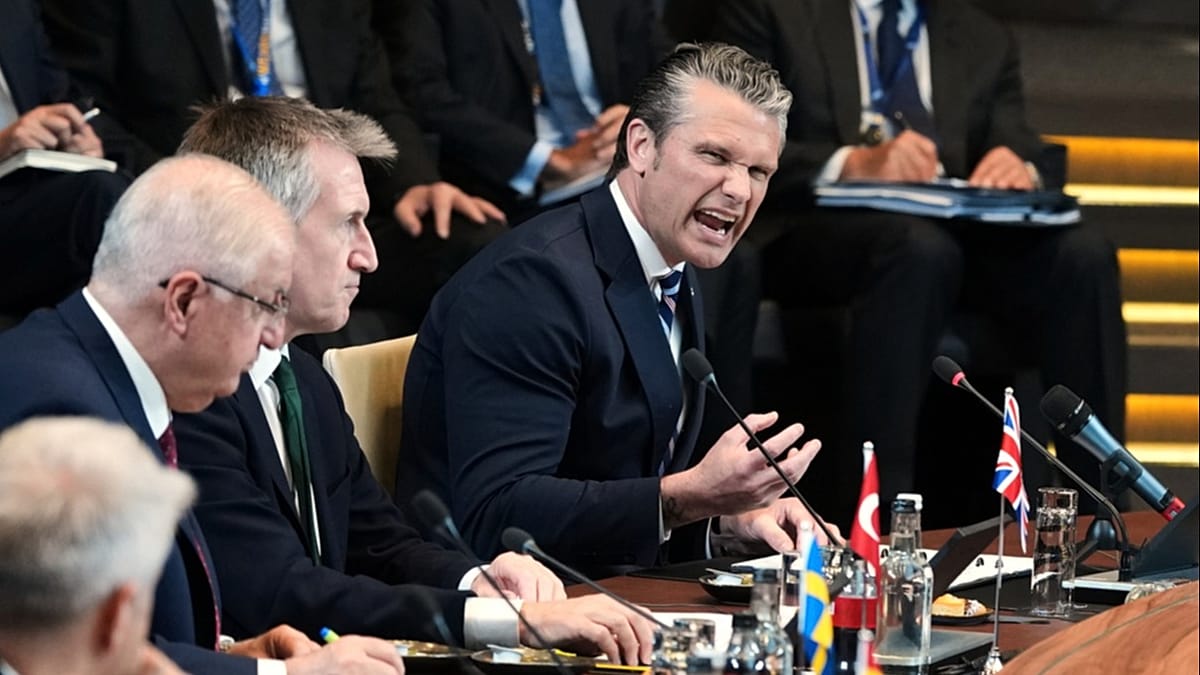
Oil prices fell sharply after Trump said the war with Iran would be over “very soon,” though they remain volatile and well above pre-conflict levels. The initial leg lower was driven by that optimism. But then Defence Secretary Pete Hegseth stepped in — and the picture became considerably more complicated. Hegseth said during a Pentagon briefing that the war with Iran would not end until “the enemy is totally and decisively defeated,” adding that this would be done on the United States’ timeline. The comments sparked worries that the conflict will last for a while yet.
The result is the chart shape you see: a sharp open-to-11am drop as Trump’s comments were digested, a brief recovery attempt around midday as buyers stepped in, and then a complete collapse after 12:30 as the Hegseth contradiction removed any remaining confidence in a swift resolution. The algorithmic selling that followed that cliff edge was brutal and unforgiving.
The Trump-Hegseth Contradiction Is the Real Story
This is not simply an oil market story. It is a story about the extraordinary confusion at the heart of US war policy — and markets are beginning to price that confusion as a risk factor in itself. The President says the war is nearly over. His Defence Secretary says it ends only with total enemy defeat. Those are not compatible positions. And in the absence of a clear, unified US government message about how and when this conflict ends, markets are left oscillating between hope and fear on every presidential statement.
Bob McNally, president at Rapidan Energy Group, said: “I think there’s a lot of optimism in the market. We saw that today with the collapse in oil prices on what we used to call verbal intervention from the president.” McNally added that the market is still struggling to process the scale of the disruption, noting that traders assumed for decades that no country would be allowed to shut the Strait.
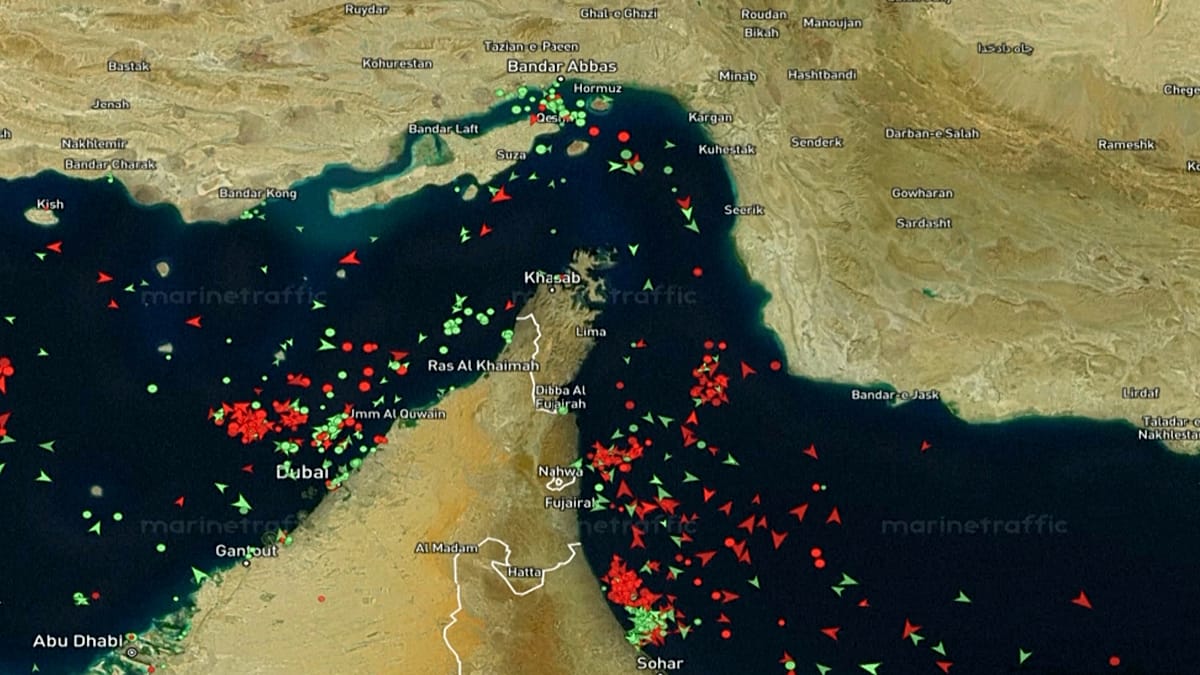
That last point is critical. The Iran war has triggered the biggest supply disruption in the history of oil, according to an analysis by Rapidan Energy. The physical reality — the Strait of Hormuz closure, Kuwait’s force majeure, Qatar’s LNG shutdown — has not changed because Trump said the war is nearly over. The fear premium has deflated. The supply disruption has not.
Where Oil Goes From Here
The intraday chart tells you something important about where the market’s head is. The recovery attempt at midday — when oil bounced back to $85.50 — shows genuine buyer interest at lower levels. Institutional investors who missed the initial rally, energy companies looking to hedge, and sovereign wealth funds from oil-producing nations all have reasons to buy at these prices. The collapse of that recovery attempt is equally telling: there is not yet enough confidence in a genuine resolution to hold those positions.
Technical structures show a massive liquidity void between $90-$95; a sudden ceasefire or G7 emergency reserve release could trigger a $20 flash crash. The current price is heavily supported by a fear premium — the moment a maritime safe corridor or ceasefire is confirmed, this premium will evaporate, with technical models suggesting an immediate 15% correction within a single trading session.
At $77.65, WTI is approaching — though not yet at — pre-war levels. The G7 emergency reserve release discussions that were designed to cap oil above $100 have been overtaken by events — verbal presidential intervention has done more in a single afternoon than weeks of coordinated policy planning.
What This Means for Inflation and Rate Decisions
The implications for central bank policy are immediate and significant. A week ago, Federal Reserve and ECB rate cut plans were being pushed well into 2027 as energy-driven inflation re-acceleration looked inevitable. At $77.65 oil, those conversations change overnight. The inflationary consequences of the oil price spike that had been feeding through supply chains begin to reverse — not immediately, but the direction of travel has shifted fundamentally.
If oil stabilises in the $75-85 range, the case for rate cuts in the second half of 2026 returns to the table. Bond markets will rally. Growth-sensitive equities will recover. The stagflation scenario that was beginning to look like base case as recently as last week becomes a tail risk rather than a central projection.
But — and this is the critical caveat — none of the physical supply disruption has been resolved. Saudi Aramco warned of the war’s potentially “catastrophic consequences” for oil markets if flows don’t resume through the vital Strait of Hormuz. The Strait remains effectively closed. Kuwait’s force majeure is still in place. Qatar’s LNG is still offline. The structural damage to Gulf energy export infrastructure does not reverse because a president gives a bullish interview.
The Investor Playbook Right Now
For investors, today’s price action creates a specific set of decisions that need to be made quickly.
Energy stocks that rallied hard during the crisis will face selling pressure as oil retreats — the windfall thesis has partially unwound. Airlines, logistics companies, and transport operators — whose costs surged as fuel prices spiked — will see relief buying. Consumer discretionary stocks will benefit as household energy budgets ease. Emerging market currencies tied to energy import costs will strengthen.
The more complex play is in bonds and rate-sensitive equities. If today’s oil move is sustained — if $75-80 becomes the new range rather than a temporary overshoot — the entire rate cut timeline re-opens and duration assets look attractive again. If the war re-escalates and oil bounces back above $90, that trade reverses painfully.
Trump is also considering reducing oil sanctions on Russia to help ease crude prices, according to three sources familiar with the matter. If that materialises, it adds another layer of downward pressure on oil prices — and another geopolitical complication that markets will need to price simultaneously.
The session’s story is ultimately one of a market searching desperately for permission to believe the worst is over — and receiving contradictory signals from the people in the best position to know. Until the Strait reopens, the force majeures lift, and the shooting actually stops, every rally in risk assets and every crash in oil prices should be treated as a trade, not a trend.
FAQ
Q: Why did oil prices crash today? WTI crude fell 5.23% to $77.65 after President Trump signalled the Iran war would end “very soon,” deflating the fear premium that had accumulated in energy markets since the conflict began. The move was amplified by algorithmic selling after a midday recovery attempt failed. However, Defence Secretary Hegseth’s subsequent statement that the war would only end with total enemy defeat created a significant contradiction that added volatility to an already unstable market.
Q: Does today’s oil price crash mean the Iran crisis is over? Not yet. While the price action reflects genuine optimism about a potential resolution, the physical supply disruption remains fully in place. The Strait of Hormuz is still effectively closed, Kuwait’s force majeure on crude exports is still active, and Qatar’s LNG facilities are still offline. Until these are physically resolved, oil prices remain vulnerable to rapid reversal if the conflict escalates again. Today’s move reflects reduced fear premium, not resolved crisis.
Q: What does the oil price crash mean for inflation and interest rates? A sustained decline in oil prices toward the $75-80 range would meaningfully reduce inflationary pressure and reopen the case for central bank rate cuts in the second half of 2026. The Federal Reserve and ECB had been forced to delay rate cut plans as energy-driven inflation threatened to re-accelerate. If oil stabilises at current levels, that calculation changes significantly — though the full inflationary pass-through from the earlier price spike will continue feeding through supply chains for several months regardless.
The post Oil Plunges 5% to $77 as Trump Signals Iran War Ending — But a New Shock Looms appeared first on European Business & Finance Magazine.