





















Greatest Managers in La Liga History
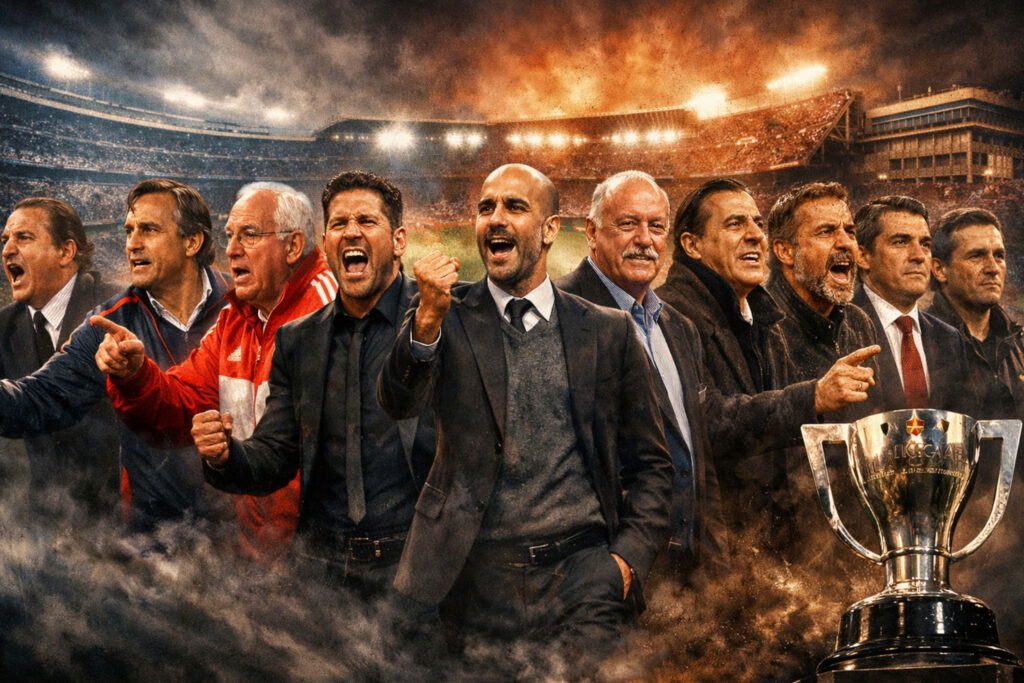
La Liga has always been a league where ideas matter. Tactics, authority, ego, patience, and sometimes sheer bloody-mindedness decide who lasts and who fades. The greatest managers here did more than win titles. They reshaped clubs, redefined styles, and left fingerprints that still show up every weekend.
Miguel Muñoz
No one looms larger over La Liga’s managerial history. At Real Madrid, Miguel Muñoz oversaw an era that blended glamour with ruthless consistency. Nine league titles across the 1960s were not built on novelty but on control. His Madrid side aged, refreshed, and kept winning. That ability to evolve without drama is why his record still stands.
Johan Cruyff
Cruyff did not just manage Barcelona. He rewired it. Four consecutive league titles in the early 1990s mattered, but the deeper impact was philosophical. Possession became a weapon rather than a comfort blanket. Youth mattered. Space mattered. Almost everything Barcelona believes about itself today traces back to Cruyff’s bench.
Luis Aragonés
At Atletico Madrid, Luis Aragonés represented defiance. He won titles as a player and as a manager, grounding Atlético in identity when chaos often threatened to swallow the club whole. His teams were emotional, organised, and rarely apologetic. That spirit still echoes through the Metropolitano.
Diego Simeone
Simeone took Aragonés’ emotional inheritance and turned it into a modern machine. Two league titles in an era dominated by financial giants should not be understated. His Atlético sides were disciplined, ferocious, and unapologetically pragmatic. He made belief a tactical tool, and he proved La Liga was not condemned to a two-team monopoly.
Pep Guardiola
Guardiola’s Barcelona felt inevitable once it got going. Three league titles in four seasons barely capture how overwhelming that team was. Possession was elevated into control at every tempo. Defending began with the striker. Watching La Liga during those years often felt like witnessing theory turned into muscle memory.
Vicente del Bosque
Del Bosque’s greatness lies in restraint. Managing egos at Real Madrid can be harder than winning matches, and he did both. Two league titles came with balance, calm authority, and a refusal to overcomplicate. His work proved that quiet leadership can survive in the loudest dressing room in Spain.
Helenio Herrera
Before modern sports science became fashionable, Herrera was already there. At Barcelona, his time was brief but influential. He introduced strict discipline, psychological preparation, and tactical rigidity that felt radical at the time. Spanish football learned that preparation could be as decisive as flair.
Rafael Benítez
Benítez’s Valencia remains one of La Liga’s great interruptions. Two league titles built on organisation, intelligence, and a squad without megastars. His teams pressed, rotated, and exploited weaknesses with clinical precision. For a moment, Valencia reminded the league that planning could still beat spending.
Luis Enrique
Luis Enrique walked into Guardiola’s shadow and refused to flinch. His Barcelona won the league with a more vertical, aggressive edge. The front three thrived on freedom rather than structure alone. It was proof that evolution does not always mean rejection. Sometimes it means loosening the reins.
Ernesto Valverde
Often underestimated, Valverde delivered consistency in a turbulent period for Barcelona. League titles came through pragmatism rather than poetry. His teams adapted to personnel rather than ideals, which is rarely fashionable but often effective. La Liga has always rewarded managers who know when to simplify.
Legacy of La Liga’s Great Managers
What unites these figures is not style but authority. Some ruled through ideas, others through emotion, others through calm management of chaos. La Liga remains a tactical laboratory because its greatest managers treated it that way. They argued with tradition, bent it, or quietly refined it until it worked better.