




































Frontex: Illegal border crossings in the EU in 2025 decreased by 26 percent
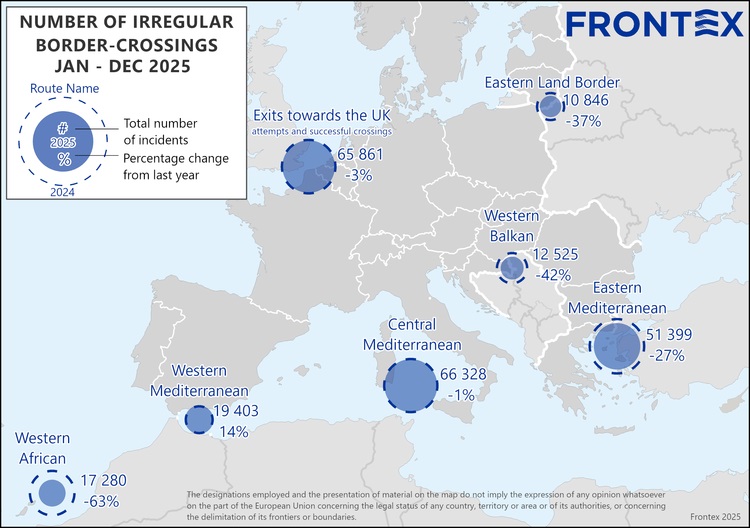
Brussels – During 2025, almost 178,000 illegal crossings of the EU’s external borders were detected, which represents a decrease of 26 percent compared to the previous year, according to preliminary data from the European Border and Coast Guard Agency (Frontex) for last year, published today.
According to Frontex, the figure of 178,000 illegal crossings is almost half lower compared to 2023 and is at its lowest level since 2021.
“Frontex works together with national authorities through joint operations, aerial and maritime surveillance, technical support and shared situational awareness. Cooperation with partner countries outside the EU also plays an important role, especially in the Western Balkans, where closer operational cooperation has helped reduce pressure and dismantle smuggling networks,” the Agency points out.
The Executive Director of Frontex, Hans Leijtens, stated that this trend shows that things are moving in the right direction, but that the risks have not disappeared.
“This decrease shows that cooperation can deliver results. But it is not an invitation to relax. It is our responsibility to remain vigilant, to support the member states on the ground and to ensure that Europe is prepared for new challenges at its borders,” said Leijtens.
According to him, preparedness and the ability to control the borders is linked to practical choices.
“This means officers on duty, ready resources and close cooperation with national authorities and partners outside the EU. This is how Frontex helps Europe remain prepared for whatever comes next,” added Leijtens.
The Frontex report emphasizes that despite the significant decrease in illegal border crossings, the situation at Europe’s borders remains uncertain, and migratory pressure can quickly change under the influence of conflicts, instability and human smuggling networks.
“The European Union is already dealing with attempts by hostile actors to exploit migration flows to put pressure on the EU’s external borders. Looking ahead, 2026 will be a key year for the management of Europe’s borders,” Frontex believes.
According to the Agency, the EU Pact on Migration and Asylum, which is due to enter into force in June this year, marks the most far-reaching reform of the European migration and asylum system in recent years and will coincide with major changes in the control of Europe’s borders, including the full implementation of the Entry/Exit System (EES) and the planned introduction of the European Travel Information and Authorisation System (ETIAS), envisaged for this year.
“If there is no major geopolitical escalation in the immediate neighborhood of the EU, the trend of decreasing illegal migration to Europe via land and sea borders that began in 2023 could continue. This will depend on sustainable cooperation with countries of origin and transit, as well as on Europe’s ability to remain prepared for sudden changes,” concludes Frontex. (15 January 2026)